Biomedical Textiles Market Set to Reach $27.74 Billion by 2030
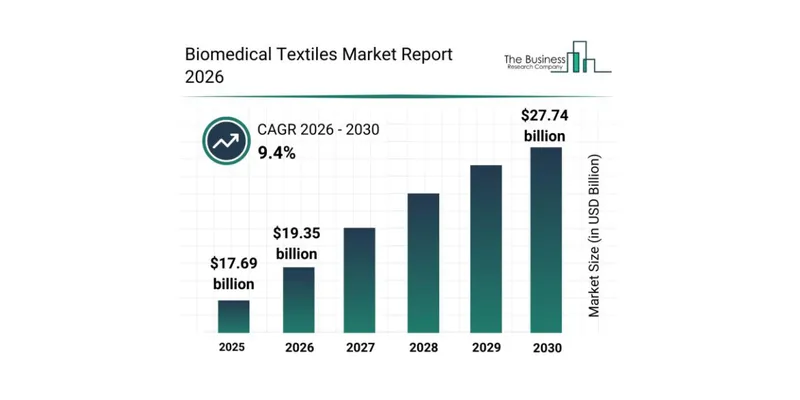
The biomedical textiles market is projected to witness steady expansion, supported by advancements in medical materials and increasing healthcare demand. Market growth is being shaped by innovations in implantable textiles and smart healthcare fabrics. Industry developments continue to focus on improving clinical outcomes and device functionality.
The biomedical textiles market is expected to grow significantly, reaching a valuation of $27.74 billion by 2030, at a compound annual growth rate (CAGR) of 9.4%. This growth is supported by the increasing adoption of bioresorbable materials, rising demand for minimally invasive surgical solutions, and expanding use of smart healthcare textiles. Investments in medical device innovation and a focus on infection prevention are also contributing to market development.
Key trends influencing the market include the adoption of advanced implantable textile materials, growing demand for antimicrobial fabrics, increased use of biodegradable fibers, and emphasis on patient safety and comfort.
The use of bioresorbable materials is a major factor driving the market, as these materials support improved integration with human tissues and reduce long-term complications. Additionally, the demand for minimally invasive surgical products is increasing, as these solutions offer reduced recovery times and fewer complications, leading to greater adoption of textile-based implants and devices.
The biomedical textiles sector includes several major companies such as Confluent Medical Technologies, Cardinal Health Inc, Johnson & Johnson Services Inc, B. Braun Melsungen AG, Smith & Nephew PLC, Medline Industries Inc, 3M Company, ATEX Technologies, Integra Life Sciences Corporation, Paul Hartmann AG, BSN Medical GmbH, Bally Ribbon Mills, Asahi Kasei Corporation, Freudenberg Medical LLC, Halyard Health, Kimberly-Clark Corporation, Milliken & Company, Mölnlycke Health Care AB, Precision Fabrics Group Inc., Secant Group LLC, Stradis Healare, Tietex International Ltd., Trelleborg AB, Vestagen Protective Technologies Inc., W.L. Gore & Associates Inc., Welspun Group, and Zimmer Biomet Holdings. These companies are involved in developing materials and expanding product offerings for medical applications.
In March 2023, Riverpoint Medical, a U.S.-based company specializing in surgical scaffolds and textile-based implants, entered an exclusive licensing agreement with DSM Biomedical. The agreement enables integration of DSM’s osteoconductive (OC) coating technology into implantable textile scaffolds and grafts. This coating supports bone in-growth and enhances regenerative outcomes. DSM Biomedical, based in the Netherlands, develops osteoconductive coatings for medical implants and tissue engineering applications.
An emerging trend in the market is the development of 3D-printed, patient-specific cementless implants within the cementless total knee arthroplasty segment. These implants incorporate porous lattice structures designed to support natural bone integration.
In April 2025, restor3D Inc., a U.S.-based medical technology company, received FDA 510(k) clearance for its iTotal Identity CR 3DP Porous Total Knee Replacement System. The system uses restor3D’s TIDAL Technology, which includes a porous lattice structure designed for bone in-growth, fatigue resistance, and load distribution. The implant components are customized to patient anatomy and are supported by patient-specific surgical instruments.
The biomedical textiles market is segmented by product type into non-implantable and implantable categories. Fabric types include non-woven, woven, and knitted biomedical textiles, while fiber types are divided into non-biodegradable and biodegradable. Applications cover ophthalmology, neurology, cardiology, dentistry, orthopedics, general surgery and treatment, and other uses. End users include hospitals, ambulatory centers, clinics, community healthcare, and other facilities.
Further segmentation includes non-implantable products such as surgical textiles, wound dressings, bandages and plasters, and compression garments. Implantable products include sutures, mesh materials, tissue engineering scaffolds, and vascular grafts. This segmentation provides insight into product applications and target end-user groups within the biomedical textiles market.