Biodegradable Textile Market to Reach USD 18.6 Billion by 2032 | 9.4% CAGR Driven by Sustainable Shift
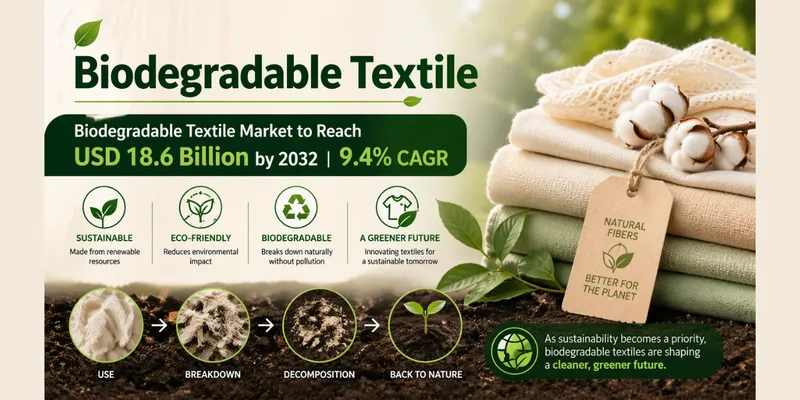
The Biodegradable Textile Market is witnessing strong global momentum as sustainability becomes a core industry priority. According to insights from Marketintelo, the market was valued at USD 7.2 billion in 2023 and is projected to reach USD 18.6 billion by 2032, expanding at a CAGR of 9.4% during the forecast period.
Globally, textile waste has exceeded 92 million tons annually, with less than 15% recycled, accelerating the shift toward biodegradable alternatives. These textiles decompose within 6 months to 5 years, compared to synthetic fibers that take over 200 years, making them a critical solution for environmental challenges.
Key Numerical Highlights
• Global market size expected to grow from USD 7.2 billion (2023) to USD 18.6 billion (2032)
• CAGR projected at 9.4% during 2024–2032
• Asia-Pacific holds 41% market share, the largest globally
• Natural fibers dominate with 54% share, while biopolymers grow fastest at 11.6% CAGR
• Global textile waste stands at 92 million tons annually, driving demand • Over USD 2.8 billion invested in R&D (2023) for biodegradable textile innovation
Market Evolution and Historical Data (2015–2023)
The Biodegradable Textile Market has expanded steadily over the past decade. In 2015, the market was valued at USD 3.1 billion, driven by niche eco-fashion brands.
By 2018, it reached USD 4.5 billion, growing at a 13.2% CAGR (2015–2018). Growth slowed during 2020, reaching USD 5.4 billion with 5.8% YoY growth, due to global disruptions.
Recovery accelerated post-2020. The market reached USD 5.8 billion in 2021, then surged to USD 6.6 billion in 2022 with 13.8% growth, followed by USD 7.2 billion in 2023, marking 9.1% YoY growth.
Year-over-Year Growth Analysis (2019–2024)
The Biodegradable Textile Market has maintained consistent annual expansion. Growth stood at 5.8% between 2019–2020, followed by 7.4% in 2021.
A strong rebound occurred in 2022 with 13.8% growth, the highest in recent years. In 2023, growth stabilized at 9.1%, and the market is projected to reach USD 7.9 billion in 2024, reflecting 10.3% growth, supported by rising sustainability investments.
Growth Drivers Backed by Data
Sustainable fashion demand is rising at 8.7% CAGR, with 67% of consumers preferring eco friendly apparel. Around 43% of consumers are willing to pay 10–20% higher prices for biodegradable products.
Government initiatives are accelerating adoption. The European Union allocated EUR 1.2 billion (2021–2027) for circular textiles, while India invested USD 350 million in 2023. The U.S. aims to reduce textile landfill waste by 30% by 2030.
Corporate investment is also significant, with USD 2.8 billion spent on R&D in 2023, and over 120 global brands committing to full sustainability by 2030.
Regional Market Insights
Asia-Pacific leads the Biodegradable Textile Market with 41% share, valued at USD 2.95 billion in 2023. China and India contribute over 65% of production, with China producing 1.8 million tons annually.
Europe holds 28% share, reaching USD 2.0 billion, with adoption growing 11.2% YoY. Germany and France account for 48% of regional demand.
North America represents 19% share, valued at USD 1.37 billion, with the U.S. market growing 10.5% annually and ESG investments rising 32% between 2022–2024.
The Rest of the World holds 12% share, growing at 8.2% CAGR, supported by investments exceeding USD 420 million.
Material and Application Analysis
Natural fibers dominate with 54% market share, followed by regenerated fibers at 28%, and biopolymers at 18%. Biopolymers are expanding rapidly at 11.6% CAGR.
In applications, apparel leads with 48% share, followed by home textiles at 22%, industrial textiles at 17%, and medical textiles at 13%, with the latter growing at 10.9% CAGR due to increased demand for biodegradable healthcare products.
Market Data Summary Table
Year | Market Size (USD Billion) | Growth Rate (%) |
2015 | 3.1 | — |
2018 | 4.5 | 13.2% |
2020 | 5.4 | 5.8% |
2021 | 5.8 | 7.4% |
2022 | 6.6 | 13.8% |
2023 | 7.2 | 9.1% |
2024 (est.) | 7.9 | 10.3% |
2032 (proj.) | 18.6 | 9.4% CAGR |
Competitive Landscape and Industry Metrics
The Biodegradable Textile Market is moderately fragmented, with the top 10 players accounting for approximately 38% of total revenue. Companies invest 5–8% of revenue in R&D, focusing on sustainable innovations.
More than 250 patents have been filed globally between 2020–2024. Technologies like waterless dyeing reduce water usage by 70–80%, while circular textile systems improve recyclability by 35%.
Future Outlook (2024–2032)
The Biodegradable Textile Market is expected to generate USD 11.4 billion in additional revenue by 2032. Biodegradable fiber production is projected to exceed 6.5 million tons annually by 2030.
Sustainable textiles are expected to increase their share in global apparel from 18% in 2023 to 35% by 2032. Technological advancements are projected to improve production efficiency by 22–28% and reduce costs by 15–20%.
Conclusion
The Biodegradable Textile Market is set for strong expansion, growing from USD 7.2 billion in 2023 to USD 18.6 billion by 2032. With a steady 9.4% CAGR, increasing regulatory support,
and rising consumer demand, the market is transitioning into a mainstream industry segment.
Asia-Pacific will continue to dominate production, while Europe and North America will lead in innovation and compliance. By 2032, biodegradable textiles are expected to account for over 25% of total textile production, reinforcing their critical role in shaping a sustainable global textile ecosystem.
Read A Full Report: https://marketintelo.com/report/biodegradable-textile-market