Bharat Tex 2026: NIFT Session Calls For Durable Fashion To Reach $350Bn Goal
Dr (Prof) Sanjay Shrivastava
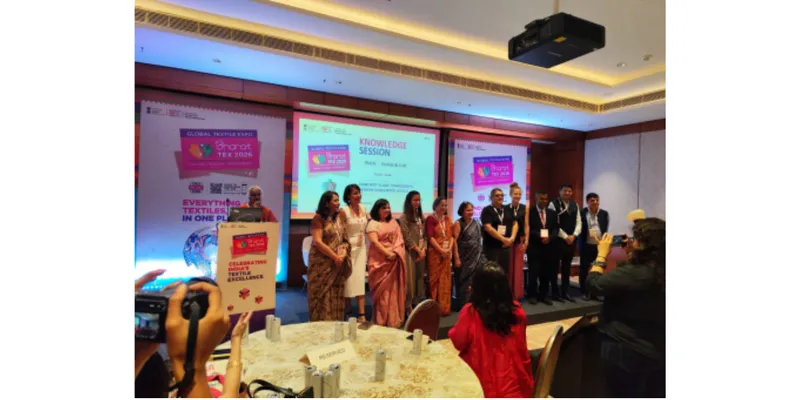
As India sets an ambitious goal of a $350 billion textile industry, experts at Bharat Tex 2026 stressed that achieving a resilient industry by 2030 hinges on moving “from fast to last” by prioritizing durable consumption over disposable fashion to phase out hazardous chemicals. At the NIFT Knowledge Session ‘From Fast to Last: Transforming Fashion Consumption in India’, held under the UNIDO - Ministry of Textiles project ‘Eliminating hazardous chemicals from textile and fashion supply chain’, panelists and audience members agreed that the answer lies in responsibility across the value chain and in reviving India’s own traditions of reuse.
Dr. Patsy Perry, Reader in Sustainable Fashion at Manchester Metropolitan University, UK, opened with data on waste. She noted that 97% of pre-consumer waste is already recycled globally. “The challenge is now solid waste management, post-consumer waste management,” she said. “Reduction is possibly not the answer but transformation is.” Citing UK research, she added that at least 10% of wardrobes remain unworn and that “thirty billion pounds of unworn clothing” sits in UK homes.
Dr. Naresh Tyagi, President, CITI, flagged the mismatch between “brands that sell glamour” and an ecosystem built on “low cost” manufacturing. The panel stressed shared responsibility. Dr. Raj Kishore Nayak, Professor at RMIT University Vietnam, said CMT manufacturers “have no voice, margin is so low” and urged brands to focus on “durability and proper care labels.” But he argued policy is the biggest lever. “Policy makers may be the greatest influencers” to enforce EPR and ESPR-style laws like in the EU. Kumar Priyadarshi added that 50 crore earners in small towns “want durable long lasting stuff” and “over production does not happen much” there. The panel highlighted another Indian strength — 11 crore SHG micro-entrepreneurs who are cutting supply chain costs by linking manufacturers directly to buyers.
A central theme was India’s cultural advantage. Dr. Perry said India already has “ancient traditional practices of chindi, upcycling, repair” while “people in the UK have mostly lost their skills now. That's a great starting point but we just need to scale it somehow.” The discussion called for a mindset shift “from ownership to stewardship, from disposal to durability, saying “the future lies not in inventing new behaviors but in rediscovering and reimaging the values. It was cited that traditional cooling methods are used in parts of China and urged India to revive similar practices.
Dr. Tyagi gave the most quoted example of the day. “When I was a kid I used my clothes like a normal sibling. If that is circular then we Indians are in that. We have forgotten.” His message to consumers was simple: “Buy durable, buy less, care well, use for longer.” He pointed to his own suit, “more than ten years old,” as proof.
Communication was identified as both a gap and an opportunity. Darshana Gajare, Head of Sustainability at Lakmé Fashion Week, said data-heavy campaigns fail because “You scrolled already.” She urged storytelling around repair, swapping and upcycling. At the same time, she warned against waiting for perfection: “We should not let perfect be the enemy of good, accept what is going on, make mistakes but keep moving on.”
Sumit, certification expert, gave the bluntest warning on greenwashing. “Sustainability packs social, environmental and economical principles into one claim. It is not possible to simplify a claim.” He said commercial pressure often pushes claims “from true to slightly misleading to pure false to a fraud.”
Session opined that consumers also need education on “what to do when the garment is coming to the end of life, and called for academia, industry and brands to work together on durability and awareness.
The panel saw hope in designers and young consumers. Darshana said “newer generations of designers are looking at design as a solution” through circular design challenges. “If this new crop of designers essentially wear what they make, they can be really strong ambassadors for mindful consumption.” She noted many are now “putting individuality first” by making basics and letting consumers style them.
On youth, Dr. Perry acknowledged they are most targeted by fast fashion and “exploring their identity,” but are also leading the shift to vintage, second-hand and experiences. “It is more about experiences,” she said. Her closing line summed up the session, “We can't buy our way to sustainability. The most sustainable option is the thing that's already in your wardrobe.”
When asked what must scale, Dr. Tyagi said execution. “We need to be more responsible in making it happen on the ground.” He also said “Fashion needs to be only responsible” and urged NIFT to rebrand as the “National Institute for Responsible and Future Technology.” The panel agreed “women of this country can be the biggest brand ambassadors of sustainability.”
The session wrapped with the audience taking the Sustainable Consumption Pledge: “I pledge to support a textile future that values people, planet, purpose and craftsmanship. I will embrace responsible sourcing, mindful consumption, ethical production, waste reduction, circular practices, respect for artisan and worker across the entire textile value chain. Through conscious choice and sustainable innovation I commit to contributing towards a cleaner, fairer and resilient textile industry.”
The consensus was clear. To reach $350 billion responsibly, India needs strict EPR enforcement, durable design with higher recycled content, scaling of SHGs and traditional skills with women as leaders, honest communication, and a national move “from fast to last.” The panel discussion was coordinated by Dr (Prof) Sanjay Shrivastava, Dr Varsha Gupta & Dr Vishu Arora.
(Author is the Director, National Institute of Fashion Technology, Ministry of Textiles, Govt. of India, Varanasi Campus)