Bharat Tex 2026 Highlights India’s Vision for a Globally Competitive and Atmanirbhar Textile Sector
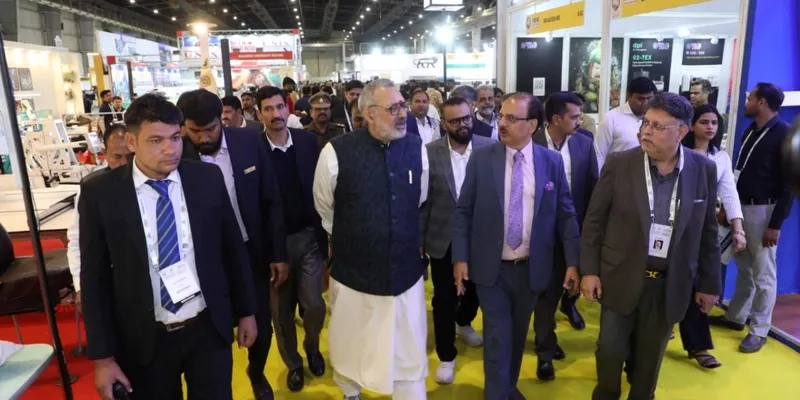
Union Minister Giriraj Singh outlines Bharat Tex 2026’s role in strengthening manufacturing, exports, sustainability, innovation and global partnerships.
Union Minister of Textiles Giriraj Singh has stated that India’s textile sector continues to play a significant role in the country’s economy by combining tradition with technology, sustainability and manufacturing scale. He noted that under the leadership of Prime Minister Narendra Modi, the 5F framework—Farm to Fibre, Fibre to Factory, Factory to Fashion, and Fashion to Foreign Markets—has provided a roadmap for the sector’s development.
According to the Minister, Bharat Tex 2026 has emerged as a platform that brings together stakeholders from across the textile value chain, facilitating business partnerships, investment opportunities, technology exchange and market access.
The third edition of Bharat Tex 2026 was organised as an industry-led initiative by 11 export promotion councils and two industry associations, with the support of the Ministry of Textiles. The event covered nearly 1.6 million sq ft, featured more than 6,000 international buyers, exhibitors from across the world and representatives from 138 countries, and recorded over 115,000 visitors.
The Minister stated that the event facilitated over 28,000 business meetings, including government-to-government and business-to-government interactions, alongside more than 100 knowledge sessions focused on trade, technology, innovation and market access.
He noted that India is increasingly being viewed as a competitive textile manufacturing hub and said that the India–UK CEPA created opportunities for exporters and MSMEs. He also referred to the signing of nine trade pacts in six years, stating that these agreements have expanded market access and strengthened India’s global textile footprint.
The article highlighted that Bharat Tex 2026 attracted investment commitments of around ₹14,300 crore, supported by over 30 Memorandums of Understanding (MoUs) involving industry players and state governments. These agreements covered man-made fibre, apparel manufacturing, technical textiles and textile recycling. Re&Up also announced its intention to invest $500 million in India to expand manufacturing capacity and generate employment.
International participation remained a key feature of the event, with representatives from Asia, Europe, the Americas, Africa and Oceania attending. Strategic collaborations included the Letter of Intent between Bharat Tex Trade Federation and Première Vision Paris, aimed at strengthening India’s integration with global markets.
Sustainability and innovation formed a major part of the exhibition. The event showcased developments in recycling, traceability, technical textiles, responsible sourcing and environmentally conscious manufacturing.
Among the announcements, NITRA (Northern India Textile Research Association) signed a Memorandum of Understanding (MoU) with Troop Comforts to utilise CLOCell (Milkweed Fibre) in cold-weather defence gear.
Innovation and technology demonstrations included AI-enabled buyer-seller matchmaking platforms, blockchain-based traceability systems, technical textile innovations, the Sanrachna Hackathon, and indigenous textile machinery innovations. The Minister also referred to the eco-friendly fabric printing machine developed by ColorJet under the National Technical Textiles Mission.
The article noted that MSMEs accounted for nearly 70% of exhibitors, while first-time exporters, startups, women entrepreneurs, weavers from Aspirational Districts Programme and Lakhpati Didi participants engaged with international buyers and markets during the event.
According to the Minister, Bharat Tex 2026 demonstrated the readiness of India’s textile sector for its next phase of growth through policy support, manufacturing capabilities, sustainability initiatives and innovation. He stated that as India progresses towards Viksit Bharat 2047, the textile sector is expected to remain an important contributor to the country’s economic development.