Battery Coating Market to Hit $1.6B by 2030, Led by EVs
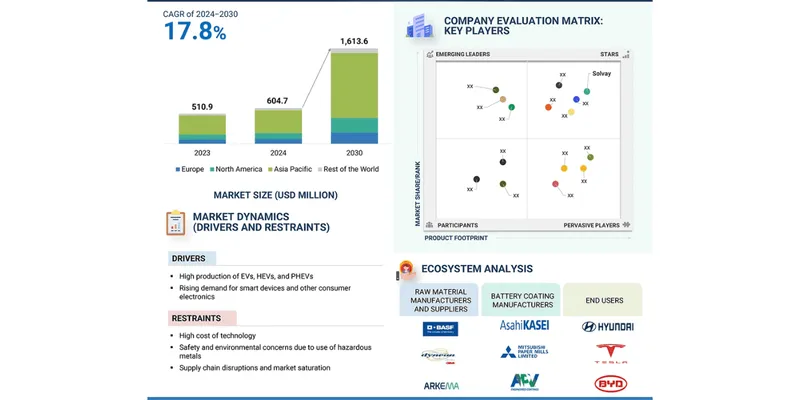
The global battery coating market is projected to surge from USD 604.7 million in 2024 to USD 1,613.6 million by 2030, reflecting a robust CAGR of 17.8%, according to a recent industry report. This exponential growth is largely driven by the increasing demand for electric vehicles (EVs) — including BEVs, PHEVs, HEVs, FCEVs, and EREVs — as well as expanding applications in renewable energy storage and consumer electronics.
The market's growth is fueled by the rising need for advanced battery technologies that offer improved efficiency, safety, and lifecycle. Battery coatings play a pivotal role in enhancing battery performance through better thermal management, chemical resistance, and cycle stability.
Among material types, PVDF (polyvinylidene fluoride) is leading the segment due to its outstanding chemical and thermal stability, strong adhesion, and solvent resistance. PVDF coatings are essential in lithium-ion battery electrodes, particularly in EVs and stationary energy storage systems, helping improve conductivity, durability, and operational reliability.
Asia Pacific is forecasted to be the largest regional market in 2023, owing to its strong EV manufacturing base. China, Japan, South Korea, and India are at the forefront of EV innovation and adoption. The presence of major companies like Asahi Kasei Corporation, Ube Corporation, and SK Innovation further drives regional dominance.
Key market participants include Arkema (France), Solvay (Belgium), Asahi Kasei (Japan), Ube Corporation (Japan), PPG Industries (US), and Mitsubishi Paper Mills (Japan), among others.