Bannari Amman Spinning Mills

Executive summary
Bannari Amman Spinning Mills has pretty much been carrying the Bannari Amman Group since starting up back in 1989.
Instead of just sticking to spinning yarn, they built out a huge setup that covers almost the whole pipeline—everything from raw cotton yarn and woven fabrics to finished clothes and home textiles.
What really put them ahead of other local players was upgrading their equipment early on. Rather than fighting for small domestic orders with tiny margins, they used better machinery and a real push toward eco-friendly production to land big international clients. It’s a brutal industry in India, but staying efficient and customer-focused has kept them right at the top.
Company overview

Bannari Amman Spinning Mills (BASML) is essentially the crown jewel of the Coimbatore-based Bannari Amman Group. They've been a major fixture in the Indian textile scene since setting up shop back in 1989. What’s interesting about their setup is that they don’t just specialize in one niche; they’ve built out the capacity to handle everything from raw cotton yarn and woven fabrics to finished retail goods like knitted clothing and home textiles. They use a mix of old-school industry experience and highly modernized, tech-heavy facilities to supply both local Indian markets and major international buyers.
- The Basic Stats: Headquartered out of Coimbatore, Tamil Nadu, they’ve been expanding their global and domestic market footprint for over three and a half decades.
- Their Operational Edge: It really comes down to their tech and sourcing. They’ve invested heavily in advanced machinery to keep quality consistent, while putting a massive focus on sustainable manufacturing—which is a huge selling point for overseas brands right now.
- The Big Picture Goal: At the end of the day, their whole strategy is about scaling up their production and chasing profitable growth without cutting corners on environmental standards.
Industry overview
Bannari Amman Spinning Mills (BASML) is a massive player in the Tamil Nadu textile scene, but they've been walking a pretty tight financial tightrope lately. Based out of Coimbatore since 1989, they are built to handle a massive pipeline—everything from raw cotton yarn and woven fabrics to home textiles. But while their production setup is huge, their bottom line has taken some massive hits from volatile cotton prices and high operating overheads, landing them in a pretty tight spot with consecutive net losses in recent years.
To keep from sinking under a heavy debt burden, the company recently made the radical call to dump its struggling garment division entirely. They are now trying to salvage their margins by focusing heavily on their highly profitable wind energy assets to subsidize the core spinning mills.
- The Sourcing Trap: Sitting in India gives them quick access to local cotton, but that hasn't saved them from getting absolutely squeezed whenever raw material costs skyrocket globally.
- The New Playbook: Their old strategy of doing everything failed. Now, they are aggressively leaning into green energy and high-margin yarn contracts to try and pull themselves out of the red.
- The Global Hurdle: Even with a massive push for eco-friendly manufacturing, they are constantly fighting a losing price war against ultra-cheap, heavily subsidized textile hubs in Bangladesh and Vietnam.
Financial performance analysis
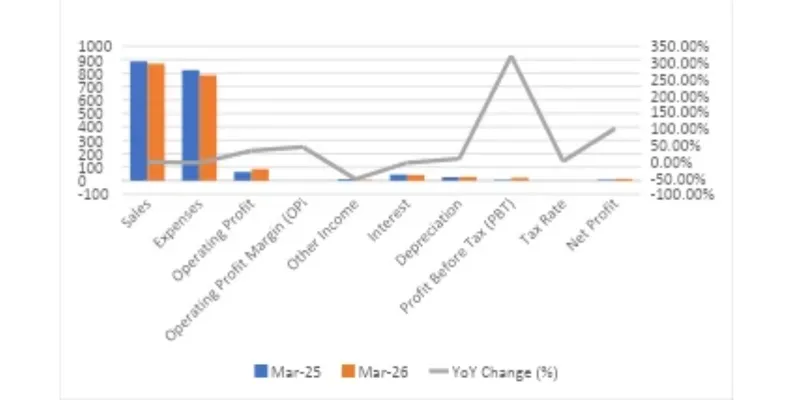
Particulars | Mar-25 | Mar-26 | YoY Change (%) |
Sales | 887 | 870 | -1.92% |
Expenses | 823 | 784 | -4.74% |
Operating Profit | 65 | 86 | 32.31% |
Operating Profit Margin (OPM) | 7% | 10% | 42.86% |
Other Income | 11 | 5 | -54.55% |
Interest | 45 | 43 | -4.44% |
Depreciation | 26 | 28 | 7.69% |
Profit Before Tax (PBT) | 5 | 21 | 320.00% |
Tax Rate | -34% | 33% | Not Meaningful* |
Net Profit | 7 | 14 | 100.00% |
Key financial ratio
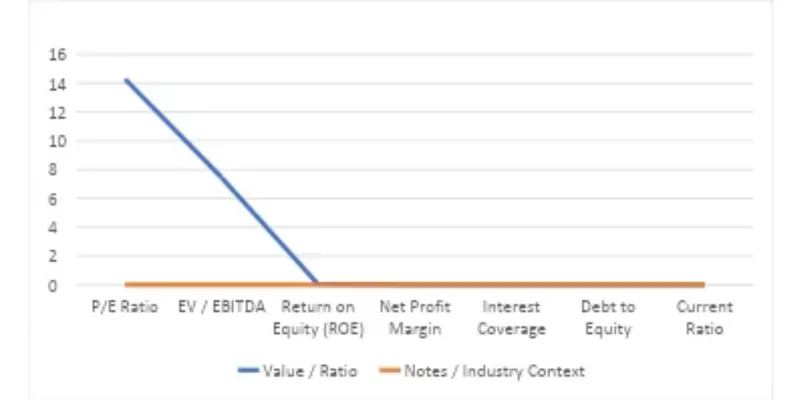
Financial Metric | Value / Ratio | Notes / Industry Context |
P/E Ratio | 14.29 | Stock trades at a premium compared to its 3-year historical average (8.1). |
EV / EBITDA | 7.45 | Lower than its 3-year average of 14.01. |
Return on Equity (ROE) | 3.00% | Marginal profitability; the company has experienced net losses in multiple recent years. |
Net Profit Margin | 0.62% | Slim margins, highly sensitive to raw material price volatility. |
Interest Coverage | 0.94x | Falls short of the standard 1.5x threshold, indicating stress in servicing debt obligations. |
Debt to Equity | 1.12x | Moderate to high leverage, though slightly improved from previous periods. |
Current Ratio | 1.09x | Barely passes the 1.0 threshold for short-term liquidity. |
Swot analysis
Strength
| Weaknesses
|
Opportunities
| Threats
|
Conclusion
Bannari Amman Spinning Mills (BASML) definitely has the scale and the setup to be a powerhouse in India's textile sector, but they are currently working through a pretty brutal industry downturn. On paper, they have exactly what international brands want—modernized facilities in Tamil Nadu, a diversified product lineup, and an early investment in green wind energy to power their operations. However, navigating the current global market has been an uphill battle, forcing management to aggressively tighten their belts, cut underperforming segments, and focus purely on high-margin yarn contracts.
References
- Bannari Amman Spinning Mills Ltd. Official Website
- Annual Reports – Bannari Amman Spinning Mills Ltd.
- BSE India – Bannari Amman Spinning Mills Ltd.
- NSE India – Bannari Amman Spinning Mills Ltd.
- Moneycontrol – Bannari Amman Spinning Mills Ltd.
- Screener – Bannari Amman Spinning Mills Ltd. Financial Analysis