Bank Spreads Rise in May 2025 Despite Policy Rate Cuts
According to the CareEdge Banking Rate Tracker – May 2025, the spread between the outstanding weighted average lending rate (WALR) and weighted average domestic term deposit rate (WADTDR) for Scheduled Commercial Banks (SCBs) rose to 2.60%, an increase of 3 basis points (bps) month-on-month.
- Lending rates on outstanding rupee loans for SCBs declined marginally by 1 bps to 9.67%, driven by rate cuts, increased competition, and reduced high-yield asset share.
- Deposit rates fell by 4 bps to 7.07%, with foreign banks seeing the sharpest drop of 14 bps, while PSBs and PVBs declined 3 bps and 2 bps, respectively.
In fresh lending, spreads widened significantly:
- SCBs: +17 bps to 3.09%
- PVBs: +34 bps to 3.86%
- PSBs: +6 bps to 1.79%
- FBs: -3 bps to 3.35%
Fresh lending rates for SCBs declined by 6 bps to 9.20%, while deposit rates fell 23 bps to 6.11%, indicating a lag in deposit repricing that enabled banks to preserve margins.
As of June 2025, the one-year median MCLR fell by 5 bps to 8.90%, though it remains 70 bps higher than pre-COVID levels. The decline was more significant for PVBs (-25 bps) and FBs (-16 bps), while PSBs saw a minimal 3 bps dip.
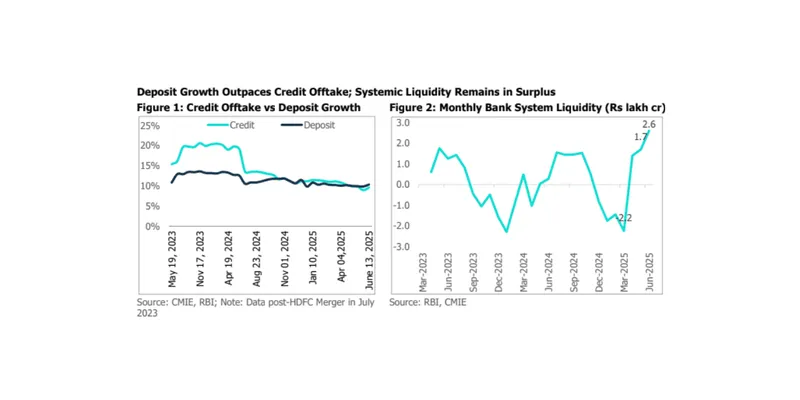
Credit offtake grew at 9.6% YoY (as of June 13, 2025), down from 15.5% YoY the previous year, reflecting a slowdown in personal loans, mortgages, and vehicle lending. In contrast, deposit growth rose by 10.4% YoY, indicating continued funding strength despite competitive pressures in bulk deposits.
Liquidity remained in surplus, with average system liquidity at ₹2.6 lakh crore in June. The RBI supported liquidity via repo auctions, OMO purchases, and FX swaps, helping smooth rate transmission.
As of March 2025, EBLR-linked loans constituted 61.6% of all floating-rate rupee loans. Private banks led in EBLR adoption with 86.5% share, while PSBs lagged at 45.9%—contributing to faster policy rate transmission among PVBs.
Sanjay Agarwal, Senior Director at CareEdge Ratings, commented:
“In May 2025, SCBs witnessed an increase in spreads amid ongoing rate transmission. Fresh spreads remained above outstanding spreads, reflecting the lag in repricing existing loans... Cheaper deposits and lower reduction in yield on advances have enabled higher spreads for the lenders.”
Overall, while credit growth momentum slowed and retail demand softened, bank spreads expanded due to favorable funding costs and liquidity, keeping margin pressures in check for now.