Bank Spreads Ease Slightly; Liquidity Supports Stability

Weaker credit demand and competitive pressures led to a slight dip in lending spreads, while surplus liquidity kept rates stable across banks.
In August 2025, scheduled commercial banks (SCBs) recorded a marginal one-basis-point drop in outstanding spreads, reflecting subdued loan demand, competitive rate adjustments, and surplus liquidity. Fresh spreads, however, held steady as banks balanced lending and deposit repricing amid persistent margin pressures.
In August 2025, the spread between SCBs’ outstanding weighted average lending rate (WALR) and weighted average term deposit rate (WADTDR) declined slightly by one basis point month-on-month (m-o-m) to 2.45%.
- Lending Rates: The average lending rate on outstanding rupee loans dropped by six basis points to 9.32%, influenced by rate cuts, reduced credit demand, and strong market competition.
- Deposit Rates: The average term deposit rate fell by five basis points to 6.87%, with declines of six bps for foreign banks, five bps for private sector banks (PVBs), and four bps for public sector banks (PSBs).
- The sharper fall in lending rates compared to deposits indicated quicker rate transmission on the credit side, as banks responded to competition and lower loan demand faster than they adjusted liability pricing.
Meanwhile, fresh spreads remained unchanged at 3.19%, as deposit costs stayed sticky and lending rates faced pressure. Surplus liquidity in the banking system limited the scope for margin expansion, though a shift toward MSME and other higher-yielding segments supported stability.
In September 2025, the one-year median MCLR held steady at 8.60%, while PSBs and PVBs saw modest declines of five and ten bps, respectively. Foreign banks, on the other hand, posted a two-bps increase to 7.05%, signaling ongoing adjustments in rate transmission.
Credit and Liquidity Trends
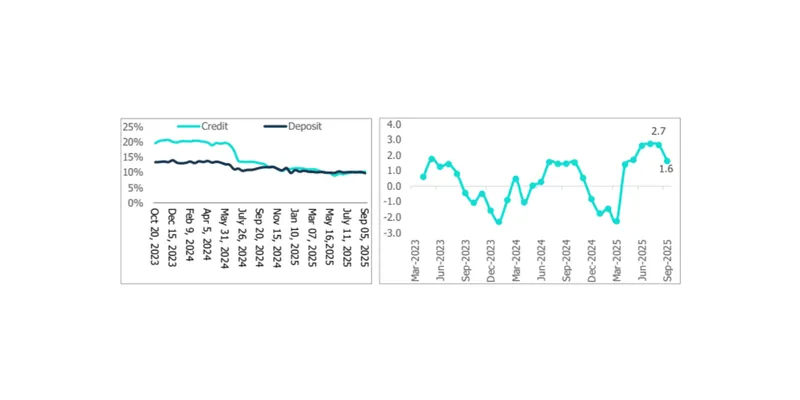
As of early September 2025, credit offtake rose 10.3% year-on-year (y-o-y), driven primarily by lending to MSMEs. Large corporates shifted some borrowings from bond markets to bank credit due to higher yields elsewhere. However, overall credit growth was slower than the 13.4% y-o-y recorded last year, constrained by subdued corporate lending, weak private capex, and lower NBFC credit flow.
Deposits grew 9.8% y-o-y to ₹236.7 lakh crore, lagging last year’s 11.2%. Time deposits grew 8.8% y-o-y, accounting for 88.7% of total deposits, while demand deposits rose 17.7% y-o-y to ₹28.9 lakh crore.
According to CareEdge Economics, liquidity conditions stayed in surplus for the sixth consecutive month, averaging around ₹1.6 lakh crore. Although tax outflows and RBI’s short forward book unwinding narrowed liquidity, CRR cuts and government security maturities helped ease pressures. Surplus liquidity continued to facilitate smooth policy rate transmission.
Interest Rate Movements
In August 2025, SCBs’ outstanding lending rate fell by six bps to 9.32%, with PSBs and PVBs recording declines to 8.70% and 10.22%, respectively. The cut in the RBI repo rate to 5.50% prompted banks to pass on rate reductions while protecting margins through loan portfolio adjustments. Outstanding deposit rates declined to 6.87%, supported by lower funding costs and gradual repricing.
On a yearly comparison, the MCLR was down 35 bps but remained 40 bps above pre-pandemic levels.
Fresh Lending and Deposit Rates
- Fresh Lending: The weighted average rate on fresh loans decreased by five bps to 8.75%, with PSBs at 8.06% and PVBs at 9.44%.
- Fresh Deposits: Rates declined 14 bps to 5.61%, with PSBs and PVBs reducing rates by 17 and 21 bps, respectively, to control funding costs.
- Spread Trends: Fresh spreads for SCBs held at 3.19%, with PVBs falling by 14 bps and PSBs marginally down by two bps.
According to the RBI’s Monetary Policy Report (October 2025), spreads were highest for education, personal, and MSME loans, with PSBs maintaining lower spreads across housing and vehicle segments compared to PVBs.
Rate Benchmark Composition
As of June 2025, 61.6% of floating-rate rupee loans were linked to the External Benchmark Lending Rate (EBLR), up from 57.5% a year earlier, while MCLR-linked loans fell to 33.8%. Private banks held a higher EBLR share (85.9%) compared to PSBs (44.6%), enabling faster transmission of rate changes.
Expert Commentary
According to Sanjay Agarwal, Senior Director, CareEdge Ratings:
“In August 2025, SCBs witnessed a marginal decline in spreads amid ongoing rate transmission and ample liquidity that reduced funding costs. Fresh spreads remain higher than outstanding spreads, indicating banks’ ability to protect margins so far. PVBs with greater EBLR-linked exposure saw faster transmission, while PSBs benefited from RBI’s liquidity measures and lower deposit costs. However, margin pressures and subdued retail credit demand have tempered aggressive credit expansion.”