Bangladesh’s Apparel Export Potential in New Zealand: Product Competitiveness and Sustainable Textile Cooperation

Md. Sajib Hossain
Research Associate,
Research and Development Cell,
Bangladesh Knitwear Manufacturers and Exporters Association (BKMEA)
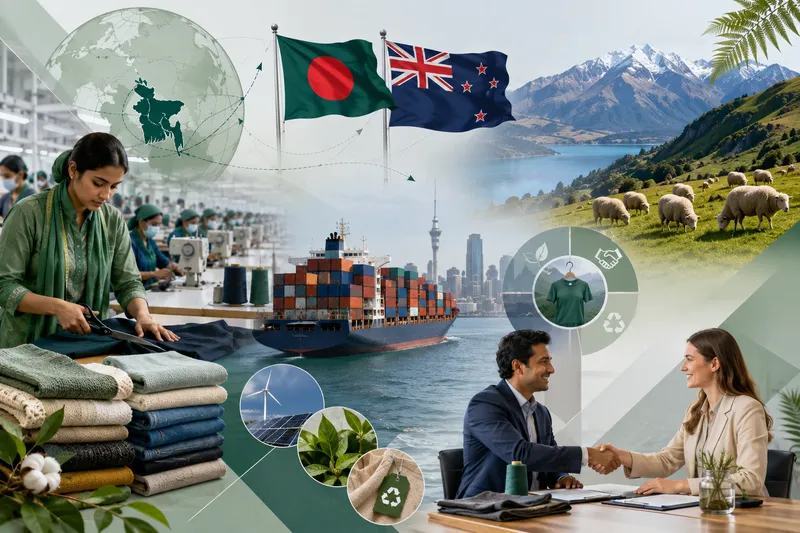
Bangladesh and New Zealand have complementary positions in the textile and apparel value chain. Bangladesh has a strong capacity to produce large-scale, cost-effective, and quality apparel products, particularly cotton-based items. Meanwhile, New Zealand has distinctive strengths in wool, natural fibres, fashion design, technology, and value-added apparel production.
New Zealand’s apparel market remained dominated by China. According to the ITC Trade Map, 2026, and the author’s calculation, in 2025, New Zealand imported apparel valued at US$1,186.94 million, a 2.93 per cent reduction from US$1,222.76 million in 2024. When it comes to New Zealand’s apparel imports from China, the value stood at US$694.41 million in 2025, accounting for around 58.50 per cent of its total apparel imports from the world market. Conversely, Bangladesh’s position was the second‑largest supplier to New Zealand’s apparel market in 2025, with imports valued at US$127.75 million and a market share of about 10.76 per cent.
However, New Zealand is not only an apparel-importing country. According to World Trade Organization (WTO) trade and tariff data, in 2025, globally, New Zealand exported US$103.58 million worth of apparel under Harmonized System (HS) codes 61 and 62. Of this, knitted apparel (HS 61) was valued at US$47.55 million, while non-knitted apparel (HS 62) stood at US$56.03 million.
This supports the view that New Zealand also has apparel and fashion-related capabilities, creating scope for cooperation with Bangladesh in design, branding, technology, and sustainable textile development.
Bangladesh’s Product-Level Competitiveness
At the product level, Bangladesh’s position in New Zealand’s apparel import market is not uniform across all apparel items. Its competitiveness is concentrated in selected cotton-based products, while its export performance remains weaker in man-made fibre apparel. As shown in Table 1, among New Zealand’s top five imported apparel products at the six-digit HS code level from the world market, Bangladesh stands out as highly competitive in cotton-based apparel, especially T-shirts (HS 610910) and men’s or boys’ cotton trousers and shorts (HS 620342). This is because imports from Bangladesh accounted for 38.09 per cent and 32.94 per cent of New Zealand’s total imports of these two products, respectively, in 2025.
Meanwhile, New Zealand’s imports of men’s or boys’ cotton trousers and shorts from Bangladesh declined by 9.91 per cent in 2025 compared with 2024. Thus, it stresses the need to retain the product’s strong position in the market.
Bangladesh also performed reasonably well in cotton jerseys, pullovers, cardigans, and similar articles (HS 611020), capturing a 15.02 per cent market share and posting 6.07 per cent growth in 2025.
Meanwhile, women’s and girls’ cotton trousers, overalls, breeches, and shorts (HS 620462) posted negative growth of 14.04 per cent in 2025 compared with 2024, although Bangladesh’s market share in this category remained notable at 21.68 per cent. Thus, it stresses the need to strengthen Bangladesh’s position in this product category by improving competitiveness and sustaining market share.
Export weakness was visible in jerseys, pullovers, and cardigans made of man-made fibres (HS 611030), which recorded negative growth of 34.04 per cent. Thus, it suggests the need to invest in synthetic and blended fabrics to capture emerging demand in this product category.
Table 1: New Zealand’s Top Five Apparel Imports from the World and Bangladesh
(Value in US$ million)
HS Code | Product Description | World 2024 | World 2025 | World Growth 2025 vs. 2024 (%) | Bangladesh 2024 | Bangladesh 2025 | Bangladesh Growth 2025 vs. 2024 (%) | Share in 2025 (%) |
610910 | T-shirts, singlets and other vests; of cotton, knitted | 95.41 | 98.17 | 2.89 | 35.49 | 37.39 | 5.36 | 38.09 |
611020 | Jerseys, pullovers, cardigans, waistcoats and similar articles; of cotton, knitted | 68.88 | 68.64 | -0.35 | 9.72 | 10.31 | 6.07 | 15.02 |
611030 | Jerseys, pullovers, cardigans, waistcoats and similar articles; of man-made fibres, knitted | 50.72 | 48.79 | -3.81 | 4.29 | 2.83 | -34.04 | 5.79 |
620342 | Trousers, bib and brace overalls, breeches and shorts; men’s or boys’, of cotton, not knitted | 53.20 | 48.56 | -8.71 | 17.76 | 16.00 | -9.91 | 32.94 |
620462 | Women’s and girls’ trousers, overalls, breeches, and shorts; of cotton, not knitted | 46.84 | 47.75 | 1.94 | 12.04 | 10.35 | -14.04 | 21.68 |
Source: Author’s calculations based on ITC Trade Map and UN Comtrade data, 2026.
Bangladesh as a Sustainable Sourcing Destination
Bangladesh’s credibility in the apparel sector, compliance, and environmental sustainability can support New Zealand’s responsible sourcing priorities. This, along with the country’s long export experience and large-scale production capacity, could help New Zealand importers source environmentally and socially responsible apparel products from Bangladesh.
Export Promotion and Market Access
To build a stronger footprint in the New Zealand market, targeted export promotion is essential. The Commercial Wing of the Bangladesh High Commission in Canberra, which is also accredited to New Zealand, may play a stronger role through buyer identification, product-level market insights, and structured matchmaking between New Zealand importers and Bangladeshi exporters. Bangladesh may also organize product showcases and buyer-supplier meetings in New Zealand, alongside invited factory visits for interested New Zealand buyers in Bangladesh. Although New Zealand offers duty-free access to Bangladeshi apparel products under Bangladesh’s least developed country (LDC) status, the 50 per cent Regional Value Content (RVC) rule may act as a barrier to expanding Bangladesh’s apparel exports. Therefore, Bangladesh needs to strengthen backward linkages in chemicals, accessories, and textiles, particularly man-made fibres (MMF) and blended-fibre inputs. Since four of New Zealand’s top five imported apparel products are cotton-based, Bangladesh should first consolidate its existing strength in cotton apparel.
To conclude, Bangladesh is highly competitive in selected cotton-based apparel items in New Zealand, particularly cotton T-shirts and men’s cotton trousers.
At the same time, cooperation between Bangladesh’s and New Zealand’s apparel and textile sectors could create opportunities in sustainable textiles and value-added apparel. This cooperation could take place through joint product development, knowledge sharing, sustainable sourcing partnerships, and fashion design collaboration.
Disclaimer: The views and analyses expressed are solely those of the author.
Disclosure note: A related article by the author titled “New Zealand as a Potential Market for Bangladesh’s Apparel Exports” was previously published in Textile Focus on June 16, 2026. This article is a revised and expanded follow-up with a different analytical focus, mainly based on HS 6-digit product-level competitiveness, product diversification, and opportunities for sustainable textile and apparel cooperation between Bangladesh and New Zealand.