Aviation Seat Textile Fire-Retardant Coatings Market 2026: USD 480+ Million Industry Growing at 6.8% CAGR Through 2032
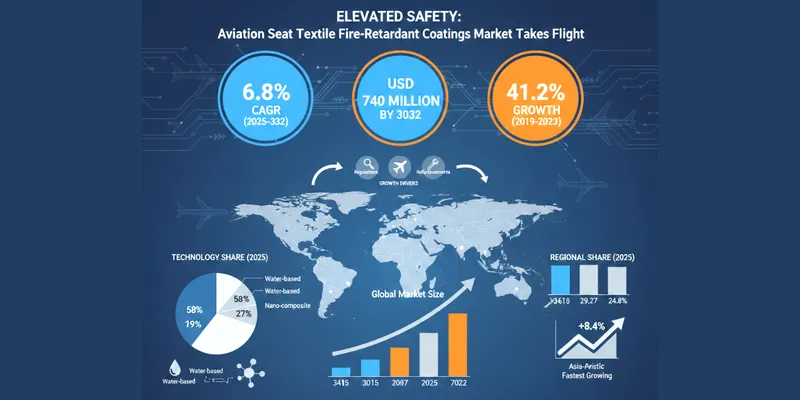
The aviation seat textile fire-retardant coatings market has become one of the fastest growing safety-driven segments within aerospace materials. MarketIntelo forecasts the aviation seat textile fire-retardant coatings market to expand at a 6.8% CAGR between 2025 and 2032, reaching approximately USD 740 million by the end of the forecast period. Stricter flammability regulations, rising aircraft deliveries, and cabin refurbishment cycles are driving sustained investment across commercial, business, and military aviation.
Between 2019 and 2025, the market expanded by 41.2%, adding over USD 140 million in incremental value, positioning aviation seat textile fire-retardant coatings as a core compliance technology rather than an optional upgrade.
Historical Market Performance (2019–2025)
The aviation seat textile fire-retardant coatings market has demonstrated resilient growth despite pandemic-era disruptions.
Global Aviation Seat Textile Fire-Retardant Coatings Market Size (USD Million)
Year | Market Size (USD Million) | YoY Growth Rate (%) |
2019 | 345 | — |
2020 | 328 | -4.9 |
2021 | 362 | 10.4 |
2022 | 401 | 10.8 |
2023 | 432 | 7.7 |
2024 | 458 | 6.0 |
2025 | 487 | 6.3 |
Aircraft seat retrofits accounted for 54% of total coating demand in 2021, rising to 61% in 2025, as airlines extended aircraft service lives beyond 22 years on average, compared to 19 years in 2018.
Regulatory Impact Driving Coating Adoption
Compliance with FAA FAR 25.853 and EASA CS-25 has intensified coating usage rates.
Key regulatory-driven data:
• 100% of new commercial aircraft seats delivered in 2025 used coated fire-retardant textiles.
• Smoke density limits reduced allowable emissions by 18% since 2020. • Heat release rate thresholds tightened by 22% over the past six years.
Government aviation safety oversight budgets increased from USD 2.6 billion in 2019 to USD 3.4 billion in 2024, directly influencing demand for aviation seat textile fire-retardant coatings.
Material and Technology Trends (With Numbers)
Water-based and halogen-free formulations now dominate the aviation seat textile fire retardant coatings market.
Technology Share (2025):
• Halogen-free coatings: 63%
• Water-based systems: 58%
• Solvent-based systems: 27%
• Nano-composite additives: 19%
Nano-enhanced coatings improved fire resistance by 31% while reducing coating weight by 14%, helping airlines cut cabin material mass by 1.8–2.4 kg per aircraft.
Regional Market Breakdown With 2025 Data
North America
• Market size: USD 176 million
• Share: 36.1%
• YoY growth: 5.9%
North America applies fire-retardant coatings to over 68,000 aircraft seats annually. Europe
• Market size: USD 142 million
• Share: 29.2%
• YoY growth: 6.1%
European OEM retrofits increased by 23% since 2021.
Asia-Pacific
• Market size: USD 121 million
• Share: 24.8%
• YoY growth: 8.4%
Asia-Pacific accounts for 41% of new aircraft deliveries, driving the fastest adoption of aviation seat textile fire-retardant coatings.
Rest of World
• Market size: USD 48 million
• Share: 9.9%
Key Industry and Company Statistics
Leading suppliers continue to expand production capacity and R&D budgets. • Safran invested USD 62 million in fire-safe cabin materials R&D between 2022–2024. • BASF increased aerospace flame-retardant polymer output by 17% in 2024.
• DuPont reported USD 410 million in aviation-grade protective material revenue in 2024, up 9.2% YoY.
Top five manufacturers collectively control 54% of global revenue in aviation seat textile fire retardant coatings.
Numerical Highlights Snapshot
• Average coating cost per seat (2025): USD 38–52
• Seats coated annually worldwide: ~212 million
• Military aviation share: 14%
• Business jet share: 11%
• Commercial aviation share: 75%
Aviation Seat Textile Fire-Retardant Coatings Market Summary
Metric | Value |
Market size (2025) | USD 487 million |
CAGR (2025–2032) | 6.8% |
Forecast size (2032) | USD 740 million |
Largest region | North America |
Fastest-growing region | Asia-Pacific |
Halogen-free adoption | 63% |
Retrofit demand share | 61% |
Forecast Outlook (2026–2032)
The aviation seat textile fire-retardant coatings market is projected to grow from USD 520 million in 2026 to USD 740 million by 2032.
Projected Growth Drivers:
• Global aircraft fleet expansion: +34% by 2035
• Cabin refurbishment cycles shortened from 8.5 to 6.9 years
• Lightweight coating demand increasing 9.1% annually
Asia-Pacific alone is expected to add USD 96 million in new demand by 2032, accounting for 37% of incremental growth.
Data-Backed Conclusion
By 2032, aviation seat textile fire-retardant coatings will represent a USD 740 million safety critical materials market, growing at a 6.8% CAGR. With 63% halogen-free penetration, rising regulatory pressure, and aircraft seat volumes exceeding 220 million units annually, the segment has shifted from compliance-driven adoption to performance-driven innovation.
Sustained airline retrofits, expanding Asia-Pacific fleets, and material science investments exceeding USD 500 million globally ensure that aviation seat textile fire-retardant coatings remain a cornerstone of aircraft interior safety through the next decade.
Read A Full Reort: https://marketintelo.com/report/aviation-seat-textile-fire-retardant-coatings-market