Automotive Aramid Fiber Market Projected to Reach USD 1,620.99 Million by 2034, Growing at 6.4% CAGR
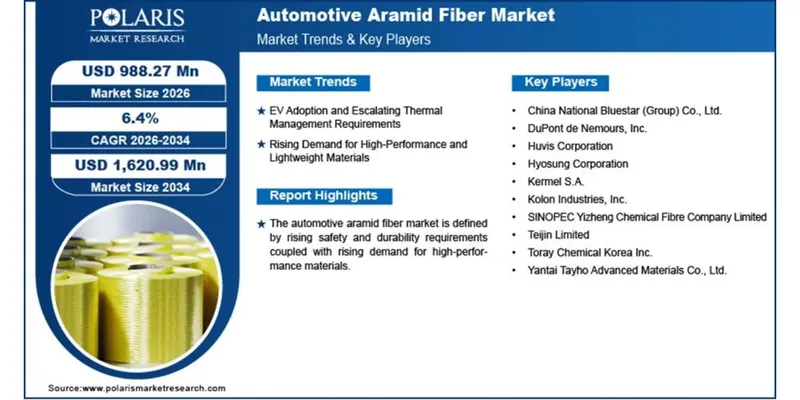
Rising electric vehicle production, demand for lightweight components and advanced material applications are supporting the expansion of the global automotive aramid fiber market.
The growing focus on vehicle safety, fuel efficiency, electrification and sustainability is increasing the use of advanced materials in automotive manufacturing. Aramid fiber, known for its high strength, lightweight properties, heat resistance and durability, is finding applications in various vehicle components, including braking systems, tires and insulation structures.
According to Polaris Market Research, the global automotive aramid fiber market was valued at approximately USD 929.82 million in 2025. The market is projected to reach USD 1,620.99 million by 2034, registering a compound annual growth rate (CAGR) of 6.4% between 2026 and 2034.
Aramid Fiber Gains Ground in Automotive Manufacturing
Aramid fibers are high-performance synthetic materials characterised by high tensile strength, impact resistance and thermal stability. These properties make them suitable for automotive components exposed to high temperatures, mechanical stress and demanding operating conditions.
Their applications include brake pads, clutch facings, tires, reinforced hoses, belts, gaskets and composite structures. Aramid fiber also offers weight-reduction benefits while maintaining component strength and durability.
With automotive manufacturers working to improve fuel economy and meet emission standards, lightweight materials that deliver reliable mechanical performance are gaining importance. Aramid fiber addresses these requirements through its combination of strength, durability and low weight.
Electric Vehicle Production Opens New Market Opportunities
The expansion of electric vehicle manufacturing is emerging as an important growth factor for the automotive aramid fiber market. EV battery systems, power electronics and high-voltage electrical components require materials capable of providing thermal protection, electrical insulation and mechanical stability.
Aramid fibers can be incorporated into insulation systems, protective layers and lightweight reinforcement structures. Their thermal and mechanical properties make them relevant to applications involving battery protection and vehicle safety.
As electric vehicle production increases globally, automotive manufacturers are exploring advanced fiber-based materials for battery protection, thermal management and structural applications. This development is creating additional opportunities for aramid fiber manufacturers and suppliers.
Para-Aramid and Meta-Aramid Serve Different Automotive Requirements
The automotive aramid fiber market is broadly divided into two categories: para-aramid and meta-aramid fibers. Each offers distinct properties suited to different automotive applications.
Para-Aramid Fibers
Para-aramid fibers are recognised for their high tensile strength, impact resistance and fatigue performance. These characteristics support their use in tire reinforcement, braking systems and structural applications requiring high mechanical strength.
Meta-Aramid Fibers
Meta-aramid fibers are primarily valued for their heat resistance and flame-retardant properties. They are used in insulation materials, heat shields and under-the-hood automotive components where thermal protection is required.
The availability of both fiber types allows manufacturers to select materials based on specific component requirements, operating conditions and safety considerations.
Major Applications Across Automotive Components
Aramid fiber is used in several areas of automotive manufacturing, with applications extending across braking systems, tires, reinforcement materials and thermal protection.
- Braking systems: Supports thermal stability, wear resistance and friction performance in brake pads and related components.
- Tire reinforcement: Its high strength makes it suitable for reinforcing tires while supporting lightweight designs.
- Hoses, belts and gaskets: Aramid reinforcement provides durability under demanding mechanical and environmental conditions.
- Insulation materials: Its thermal properties support applications requiring heat resistance and protection.
- Composite components: Aramid fibers contribute to impact resistance, structural reinforcement and vehicle weight reduction.
These applications demonstrate the role of high-performance fibers in automotive component development and manufacturing.
Asia Pacific Maintains a Leading Market Position
Asia Pacific holds a leading position in the global automotive aramid fiber market, supported by its established automotive production and component manufacturing industries.
China, India, Japan and South Korea are among the important automotive manufacturing centers in the region, contributing to demand for advanced materials and high-performance components.
North America is also expected to record significant market growth, supported by electric vehicle adoption and rising demand for advanced automotive materials.
In Europe, demand is linked to the automotive industry's focus on vehicle efficiency, lightweight construction and environmental regulations.
High Costs and Alternative Materials Remain Key Challenges
Despite its technical advantages, the wider adoption of aramid fiber faces certain challenges. High production costs remain a consideration for automotive manufacturers, particularly when evaluating material affordability across large-scale production.
Aramid fibers also face competition from alternative reinforcement materials, including glass fiber and carbon fiber. Manufacturers must assess the balance between performance requirements and material costs when selecting suitable solutions.
However, developments in recyclable fibers, advanced composites and electric vehicle technologies are expected to create further opportunities for the market.
Outlook: Aramid Fiber's Role in Next-Generation Vehicles
The automotive industry's transition towards lightweight construction, improved safety and electric mobility is creating new requirements for advanced materials. Aramid fiber's combination of tensile strength, thermal resistance and durability makes it relevant to a growing range of automotive applications.
With the global automotive aramid fiber market projected to reach USD 1,620.99 million by 2034, its adoption across conventional and electric vehicle components is expected to remain an important area of development for the automotive materials sector.