Australian Cotton Exports Reach 2.3 Million Bales as 2027 Crop Estimate Rises to 3.5 Million
The November 2026 ACSA Market Report highlights slower September shipments, subdued demand for Australian cotton and improved planting prospects following significant rainfall across major growing regions.
Australia's 2026 cotton season is effectively complete from a purchasing and receival perspective, with marketing and export shipments continuing. According to the November 2026 ACSA Market Report, approximately 2.3 million bales were exported between May and September, while improved rainfall in late October has lifted the estimated size of the 2027 crop from 3 million to 3.5 million bales.
Australian Cotton Exports Reach 2.3 Million Bales by September 2026
With only one gin still processing Australian 2026 crop cotton, the season has largely concluded in terms of purchasing and receivals. However, marketing and shipping activities remain ongoing, with slightly more than 50% of the crop estimated to have been exported by the end of September.
Export figures show that 2.3 million bales were shipped between May and September 2026. Assuming a total crop of 4.5 million bales, approximately 2.2 million bales remain to be shipped from October onwards.
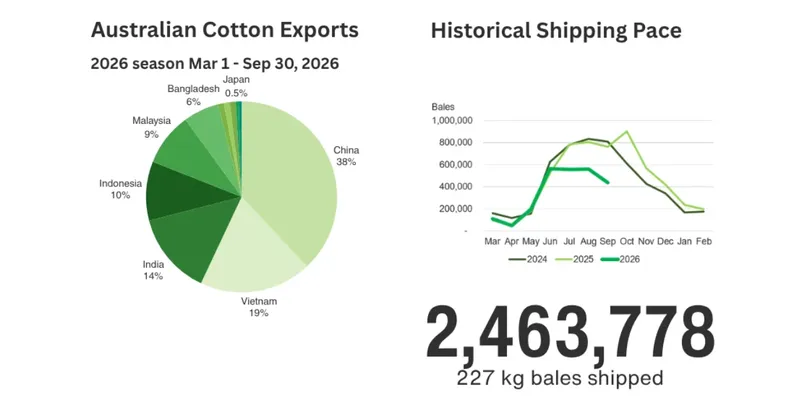
September shipments declined to 436,000 bales compared with 558,000 bales in August, reflecting the subdued demand conditions experienced across much of the year.
China, India and Vietnam each accounted for slightly more than 20% of Australia's cotton exports during September.
Indian Import Duty Waiver Influences Australian Cotton Shipments
Shipments to India have been significantly influenced by the removal of import duties. The waiver, which was originally scheduled to expire at the end of October, has now been confirmed for an extension through to the end of December following speculation about its continuation.
However, Australian exporters may face challenges in taking advantage of the extended waiver unless shipments are already in transit.
Brazilian Cotton Demand Improves as Australian Buying Remains Subdued
Traders reported improved buying activity across most markets during October, particularly for Brazilian cotton offered at more competitive prices.
Demand for Australian cotton, however, remained relatively subdued. Merchants generally maintained firm basis levels ahead of the transition from December 2026 to March 2027 futures.
March futures have been trading at a premium of almost 4.00 US cents/lb over December futures, creating a carry market that gives merchants an incentive to retain cotton rather than sell immediately.
As a result, the remaining Australian 2026 crop may be shipped gradually over the coming months instead of being released into the market in larger volumes.
Rainfall Lifts Australia's 2027 Cotton Crop Estimate to 3.5 Million Bales
The outlook for Australia's 2027 cotton crop improved in late October following significant rainfall across large parts of the country's cotton-growing regions.
Rainfall of up to 150 mm in some areas has encouraged additional planting activity, increasing crop estimates by approximately 500,000 bales, from 3 million to 3.5 million bales.
A significant portion of the expected increase is likely to come from Queensland's Darling Downs and Border Rivers regions, alongside expanded dryland plantings in north-west New South Wales.
Waterlogging and Cool Weather Create Replanting Requirements
Although the rainfall has generally supported planting prospects, some areas have required replanting because of waterlogging and cooler weather conditions.
With the optimal planting window beginning to close, growers would now benefit from a period of warm and dry weather to support crop establishment.
The coming months will therefore be important for the development of the 2027 Australian cotton crop, while exporters continue working through the remaining shipments from the 2026 season.