Arvind & Peak Launch India’s First Cotton-Stalk Torrefaction Plant
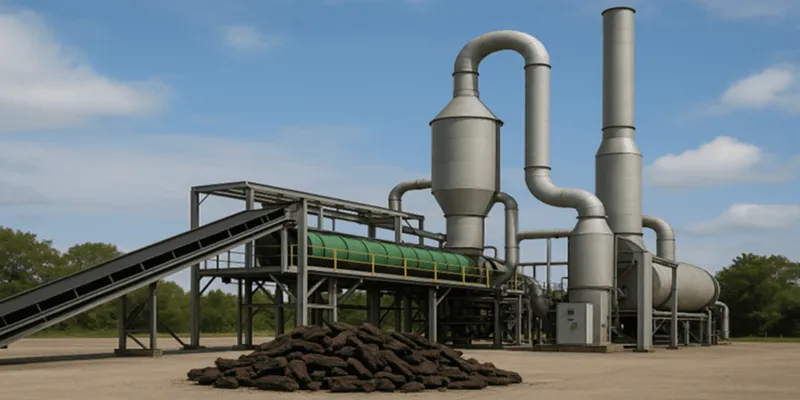
A pioneering waste-to-energy project advancing textile decarbonization.
Arvind Limited and Peak Sustainability Ventures have partnered to build India’s first industrial-scale cotton stalk torrefaction plant in Gujarat, supporting large-scale decarbonization and clean energy transition in textiles.
Arvind Limited, one of India’s most established textile-to-retail conglomerates, has partnered with Peak Sustainability Ventures, a Mumbai-based global climate-focused investment firm, to set up India’s first industrial-scale cotton stalk torrefaction plant in Gujarat. With an annual capacity exceeding 40,000 tonnes, this initiative aims to significantly advance Arvind’s decarbonization strategy and pave the way for large-scale adoption of torrefaction technology in India.
The facility will convert cotton stalks into torrefied biomass, enabling a cleaner, coal-equivalent fuel that can directly replace fossil fuels in Arvind’s manufacturing boilers. As the country’s first major torrefaction project for cotton stalks, it is designed to serve as a viable, scalable model for industries seeking to transition from coal to biomass-based solutions.
Commenting on the development, Mr. Punit Lalbhai, Vice Chairman, Arvind Limited, stated, “At Arvind, sustainability is not just a goal; it’s a journey with a sense of responsibility. We are innovating in all parts of our value chain to improve our sustainability and long-term business and meet our SBTI targets. This torrefaction project with Peak is one of the best examples of circular economy and waste-to-energy we have seen in the textiles space, exemplifying what a regenerative textile ecosystem can look like. I am proud to announce this collaboration as a bold step toward responsible manufacturing at scale.”
Mr. Samir Shah, Managing Partner, Peak Sustainability Ventures, added, “We are excited to partner with Arvind Limited, a globally recognized player in the textiles sector, on this landmark project. Through this collaboration, we hope to provide validation to the broader industry that waste-to-energy solutions can be economical, circular, and importantly, catalytic in accelerating India’s transition away from fossil fuels. At Peak, our core mission is to make a large impact on India’s sustainability goals, and we believe this pioneering project with Arvind can play a key role in that journey.”
Peak played a central role in designing the reactor, identifying the technology partner, and financing the project. For Arvind, the initiative is a key driver in its ambition to become fully coal-free by 2030. At a regional level, the project boosts employment, generates economic activity, and creates productive use of cotton stalks that are often burnt or left to decompose. It also enables Arvind’s global customers to reduce Scope 3 emissions through a decarbonized supply chain—an increasingly important requirement for fashion and apparel brands.
For Peak, the project aligns with its mission to help India leverage its vast stock of agricultural waste for clean energy, accelerating the country’s broader sustainability transitions.
Torrefaction as a Decarbonization Pathway for Textiles
India generates over 500 million tonnes of agricultural waste annually, most of which is either disposed of or openly burned. In cotton farming, only about 15% of the plant—fiber and seed—is utilized, leaving behind 85% as cotton stalk, a woody biomass typically left in the field. As a major Indian textile mill, Arvind works with more than 90,000 cotton farmers and already uses stalks for thermal energy. Torrefaction, however, significantly enhances the energy value and efficiency of the biomass.
This initiative showcases a circular and scalable model for converting cotton by-product into a valuable low-carbon fuel for manufacturing, with the potential to expand to include the production of biochar for farmers—supporting soil health, improved yields, and regenerative agriculture.
Torrefaction improves the energy density, stability, and handling properties of biomass and can increase calorific value by up to 20%. The resulting torrefied biomass mimics coal and can replace up to 100% of coal in industrial boilers with no major retrofits. Arvind will use the torrefied material to fulfill at least 20% of its thermal energy needs, with scope for higher adoption over time. If successful, the project can be scaled to meet broader industrial requirements and replicated across agricultural regions.
Arvind has also received support from the Apparel Impact Institute (Aii) through its Climate Solutions Portfolio Grant. Aii selected the project because it provides a cost-efficient, scalable pathway for textile factories to transition from coal to biomass without major capital expenditure.
Peak’s Role as a Climate Investor
Peak has collaborated closely with Arvind over the past year to shape this project, identify a leading European technology partner specializing in torrefaction and biochar solutions, and structure funding for capital and operational needs.
With Arvind serving as the long-term offtake partner and biomass supplier, the project strengthens Arvind’s sustainability credentials and accelerates its decarbonization goals. Peak and Arvind are also in discussions with global stakeholders interested in participating in this first-of-its-kind waste-to-energy initiative.
Both organizations ultimately aim to create a scalable, financially sound waste-to-energy platform that helps reduce India’s dependence on fossil fuels. They believe torrefaction can play a pivotal role in India’s long-term sustainability transition.