Antibacterial Textile Market Growth to USD 18.5 Billion by 2032
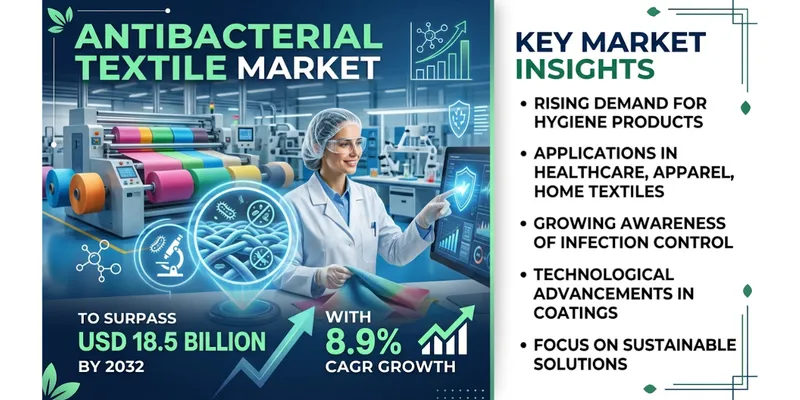
The antibacterial textile market was valued at USD 10.2 billion in 2023 and grew to USD 11.1 billion in 2024, registering a year-on-year increase of 8.8%. It is projected to reach USD 12.1 billion in 2025 and further expand to USD 18.5 billion by 2032, growing at a CAGR of 8.9% during the 2024–2032 period.
Historically, the market has maintained consistent growth, rising from USD 6.4 billion in 2016 to USD 8.7 billion in 2019, reflecting a CAGR of 10.8%. During the pandemic period, the market reached USD 9.3 billion in 2020, followed by USD 9.8 billion in 2021 and USD 10.0 billion in 2022. Growth stabilized post-pandemic before accelerating again in 2023 and 2024.
Product segmentation shows silver-based antibacterial textiles holding the largest share at 38% in 2024, followed by copper-based textiles at 21%, organic agents at 27%, and other materials at 14%. While silver-based solutions dominate due to efficiency, cost factors influence broader adoption.
In terms of application, healthcare textiles account for 32% of the market in 2024, including hospital linens, surgical gowns, and masks. Sportswear and activewear contribute 24%, followed by home textiles at 19%, industrial textiles at 15%, and other sectors at 10%.
Regionally, Asia-Pacific leads with a 41% market share in 2024, valued at USD 4.6 billion, and is projected to grow at a CAGR of 9.6%. North America holds a 26% share, followed by Europe at 22% and the rest of the world at 11%. China and India contribute significantly to Asia-Pacific demand, while the United States accounts for a major share in North America.
Investment activity continues to support market expansion, with global R&D investment exceeding USD 1.3 billion in 2024. India allocated USD 1.1 billion toward technical textiles between 2023 and 2025, while the United States invested USD 650 million in antimicrobial material research between 2022 and 2024. China has also expanded textile production capacity by 12% annually since 2021.
Production volumes reached 4.8 million tons in 2024 and are expected to grow to 7.2 million tons by 2032, with an average annual growth rate of 7.5%. Asia-Pacific contributes approximately 55% of global output.
The competitive landscape remains moderately consolidated, with key players generating over USD 5.5 billion in revenue in 2024 and accounting for nearly 50% of the market. Product innovation cycles have shortened to 14 months, while 30% of new product launches in 2024 are categorized as eco-friendly.
Emerging trends include a 28% increase in demand for sustainable antibacterial textiles between 2022 and 2024, 11.2% CAGR growth in smart textiles, and a 34% year-on-year rise in online sales of antibacterial home textiles in 2024.
Looking ahead, the market is projected to reach USD 13.2 billion by 2026, USD 15.5 billion by 2028, USD 17.1 billion by 2030, and USD 18.5 billion by 2032. Healthcare applications are expected to remain dominant, while sportswear and home textiles are anticipated to grow at faster rates in specific regions.
Read A Full Report: https://marketintelo.com/report/antibacterial-textile-market