Anti-Viral Textile Finish Market to Exceed USD 1.9 Billion by 2032 Amid 11.8% CAGR Growth
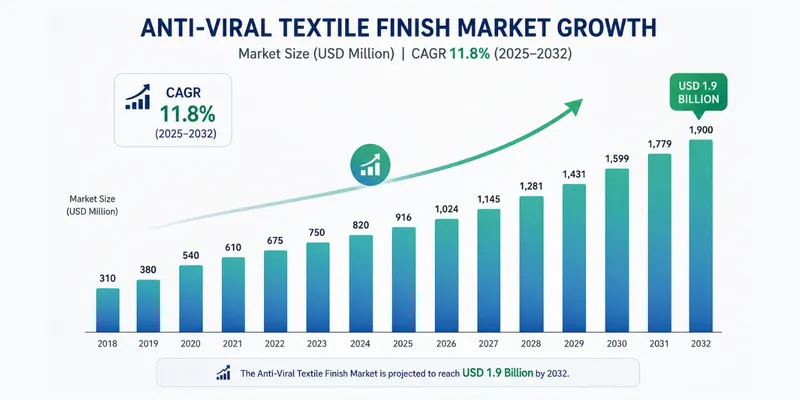
The global Anti-Viral Textile Finish market is witnessing accelerated expansion as healthcare, sportswear, hospitality, and defense industries increase investments in antimicrobial and virus-resistant fabrics. According to recent industry analysis by Marketintelo, the global market was valued at nearly USD 820 million in 2024 and is projected to surpass USD 1.9 billion by 2032, expanding at a CAGR of 11.8% between 2025 and 2032.
The surge in healthcare-associated infections and post-pandemic hygiene awareness has significantly boosted demand for Anti-Viral Textile Finish technologies. In 2025 alone, global spending on antimicrobial and protective textiles exceeded USD 14.6 billion, with anti-viral coatings accounting for approximately 12.4% of total functional textile investments.
Key Numerical Highlights
• Global Anti-Viral Textile Finish market size reached USD 820 million in 2024. • Market projected to hit USD 1.9 billion by 2032.
• CAGR estimated at 11.8% from 2025–2032.
• Healthcare textiles accounted for 41% market share in 2025.
• Asia-Pacific contributed 38.6% of global revenues in 2025.
• Silver-ion based finishes represented 46% of product demand.
• North America invested over USD 2.1 billion in smart healthcare fabrics during 2024. • Europe recorded 14.2% YoY growth in anti-viral protective apparel demand. • Sportswear applications grew 18.7% in 2025 compared to 2024.
• Textile chemical manufacturers increased R&D spending by 21% between 2022 and 2025.
Historical Market Performance Shows Strong Momentum
The Anti-Viral Textile Finish market expanded steadily over the last decade. In 2018, the industry was valued at approximately USD 310 million. By 2020, pandemic-driven demand pushed revenues above USD 540 million, reflecting a sharp 74% increase within two years.
Between 2021 and 2024, the market experienced sustained growth averaging 10.6% annually. Demand for reusable protective clothing increased by 32% globally during this period, while antiviral hospital linen procurement rose by nearly 27%.
Textile producers across China, India, Germany, and the United States collectively increased production capacity for treated fabrics by 39% from 2021 to 2025.
Regional Analysis: Asia-Pacific Leads Global Demand
Asia-Pacific
Asia-Pacific dominates the Anti-Viral Textile Finish market with 38.6% global share in 2025. China accounted for nearly USD 170 million in revenues, while India witnessed 15.4% annual growth in antiviral textile exports.
Japan and South Korea collectively invested over USD 620 million in advanced nano-coating technologies between 2022 and 2025.
North America
North America represented 29.4% of the global market in 2025. The United States generated over USD 210 million in anti-viral textile revenues due to rising hospital infrastructure spending and defense textile procurement.
The U.S. healthcare sector consumed approximately 1.3 billion square meters of antimicrobial fabrics in 2024, marking an 18% increase from 2022.
Europe
Europe captured 24.1% market share in 2025. Germany, France, and the UK remained major innovation hubs for Anti-Viral Textile Finish technologies.
European Union investments in sustainable protective textiles exceeded USD 780 million in 2024. Demand for eco-friendly antiviral finishes increased 22% year-over-year across European apparel manufacturers.
Technology Trends and Material Innovations
Silver nanoparticle coatings remain the dominant technology, contributing 46% of global revenues in 2025. Copper-based finishes accounted for 21%, while bio-based antiviral treatments represented nearly 14%.
Manufacturers are increasingly focusing on wash durability. Modern Anti-Viral Textile Finish solutions can retain up to 95% viral reduction efficiency after 30 industrial wash cycles, compared to only 60% efficiency retention in 2019 products.
Smart textile integration also accelerated rapidly. The smart antiviral fabric segment recorded 19.3% annual growth in 2025 due to rising adoption in military uniforms and wearable healthcare devices.
Industry Statistics and Competitive Landscape
More than 240 companies globally are actively manufacturing antiviral textile chemicals and treated fabrics. The top 10 manufacturers controlled approximately 48% of market revenues in 2025.
Research investments increased substantially:
Segment | 2020 Value | 2025 Value | Growth |
Healthcare Textiles | USD 180 Mn | USD 410 Mn | 127% |
Sportswear Applications | USD 62 Mn | USD 145 Mn | 134% |
Hospitality Textiles | USD 48 Mn | USD 101 Mn | 110% |
Defense Applications | USD 39 Mn | USD 96 Mn | 146% |
Global patent filings related to Anti-Viral Textile Finish technologies rose from 1,820 filings in 2019 to over 4,900 filings in 2025, indicating strong innovation activity.
Future Outlook Through 2032
The future of the Anti-Viral Textile Finish market remains highly promising as hygiene focused consumer behavior becomes permanent across multiple sectors. By 2030, antiviral treated fabrics are expected to account for 18% of all functional textile production globally, up from 7% in 2024.
Healthcare and sportswear applications will remain primary revenue generators, while hospitality and public transportation sectors are expected to witness double-digit adoption growth through 2032.
With rising government investments, expanding textile exports, and technological advancements improving durability and sustainability, the global Anti-Viral Textile Finish market is forecast to surpass USD 1.9 billion by 2032, creating substantial growth opportunities for textile chemical manufacturers and fabric producers worldwide.
Read A Full Report: https://marketintelo.com/report/anti-viral-textile-finish-market