Anti-Mosquito Textile Finish Market to Reach USD 1.85 Billion by 2030 at 8.7% CAGR
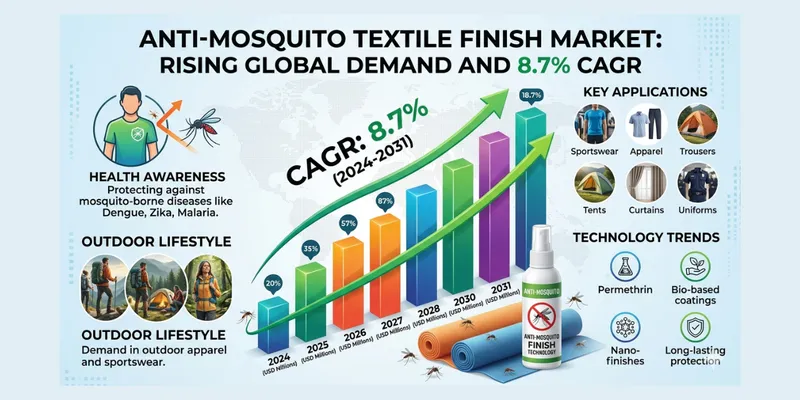
According to recent insights by Marketintelo, the global Anti-Mosquito Textile Finish market is witnessing steady expansion, driven by increasing demand for protective and functional textiles. The market was valued at approximately USD 1.05 billion in 2024 and is projected to reach USD 1.85 billion by 2030, growing at a CAGR of 8.7% during the forecast period.
The rise in mosquito-borne diseases such as dengue and malaria, which affect over 390 million people annually worldwide, is a key growth catalyst. Additionally, the functional textile segment has grown by 6.5% YoY in 2023, indicating increasing consumer preference for value-added fabrics.
Market Evolution: Historical Growth and Year-on-Year Expansion
The Anti-Mosquito Textile Finish market has demonstrated consistent growth over the past decade, supported by increasing public health awareness and textile innovation.
• In 2016, the market size stood at USD 620 million
• By 2019, it reached USD 780 million, reflecting a CAGR of 7.9%
• In 2021, the market crossed USD 920 million, despite pandemic disruptions
• From 2022 to 2024, the market grew from USD 980 million to USD 1.05 billion, marking a ~7.1% YoY growth
The acceleration post-2020 highlights increased consumer focus on hygiene and safety textiles, particularly in tropical and subtropical regions.
Key Numerical Highlights Driving the Market
• Over 65% of global demand comes from Asia-Pacific and Africa combined • Textile-based repellents reduce mosquito contact by 70–90% effectiveness rate • Over 40% of outdoor apparel brands now incorporate anti-mosquito finishes
• Government spending on malaria prevention exceeded USD 3.3 billion globally in 2023
• Functional textiles account for ~28% of total technical textile market share These data points indicate strong cross-sector adoption, from healthcare to outdoor apparel.
Technology Trends and Product Penetration
The Anti-Mosquito Textile Finish market is evolving through chemical and natural-based innovations. Synthetic agents like permethrin dominate with a market share of nearly 55%, while plant-based alternatives (citronella, neem) are growing at a faster CAGR of 10.2%.
In terms of application:
• Apparel segment holds ~48% market share
• Home textiles contribute 32%
• Industrial and military applications account for 20%
Penetration rates in outdoor clothing have increased from 18% in 2018 to over 37% in 2024, reflecting rapid adoption.
Regional Analysis: Asia-Pacific Leads, North America Expands
Regionally, the Anti-Mosquito Textile Finish market shows uneven but promising growth patterns.
Market Share by Region (2024)
• Asia-Pacific: 38% (USD 399 million)
• North America: 24% (USD 252 million)
• Europe: 21% (USD 220 million)
• Rest of World: 17% (USD 179 million)
Asia-Pacific dominates due to high disease prevalence and textile manufacturing hubs like India and China. The region is growing at a CAGR of 9.5%, the highest globally.
North America, however, is witnessing strong growth driven by outdoor lifestyle trends, with anti-mosquito apparel sales increasing by 12% YoY in 2023.
Demand Drivers: Health Awareness and Outdoor Lifestyle Trends
The Anti-Mosquito Textile Finish market is heavily influenced by both health and lifestyle factors. Rising cases of dengue have increased by 8% annually over the last five years, pushing demand for preventive solutions.
Simultaneously, outdoor recreation spending globally crossed USD 1.2 trillion in 2023, driving demand for protective apparel. In urban markets, nearly 45% of consumers prefer multifunctional clothing, further boosting adoption.
Additionally, military and defense sectors account for approximately USD 120 million in annual procurement, emphasizing the strategic importance of these textiles.
Investment and Production Landscape
The market has witnessed significant investment in R&D and production capabilities. • Global investment in functional textile R&D exceeded USD 1.1 billion in 2023 • Production volumes of treated fabrics increased by 6.8% YoY
• Leading manufacturers allocate 8–12% of revenue toward innovation
India alone produces over 18% of the world’s treated textile output, supported by government initiatives under technical textile missions with funding exceeding USD 200 million.
Market Data Summary (Text Table)
Global Anti-Mosquito Textile Finish Market Overview
Year | Market Size (USD Billion) | Growth Rate (%) |
2016 | 0.62 | 6.8% |
2018 | 0.72 | 7.2% |
2020 | 0.88 | 6.5% |
2022 | 0.98 | 7.0% |
2024 | 1.05 | 7.1% |
2026* | 1.28 | 8.3% |
2030* | 1.85 | 8.7% |
Competitive Landscape and Company Performance
The Anti-Mosquito Textile Finish market is moderately fragmented, with both chemical companies and textile manufacturers competing.
Key players collectively hold around 55–60% market share, with strong regional players dominating Asia-Pacific.
• Top 5 companies account for ~38% of global revenue
• Average operating margins range between 12–18%
• Product innovation cycles have shortened to 12–18 months
Companies are increasingly focusing on eco-friendly formulations, as regulatory pressure rises, particularly in Europe where over 25% of chemical finishes face compliance scrutiny.
Regulatory and Environmental Considerations
Environmental regulations are shaping the Anti-Mosquito Textile Finish market significantly. • EU REACH regulations impact over 30% of chemical-based finishes • Biodegradable finishes are growing at 11% CAGR
• Over 50 countries have introduced stricter textile chemical standards
Compliance costs have increased by 15–20% for manufacturers, influencing pricing strategies and profit margins.
Future Outlook: Strong Growth with Innovation-Led Expansion
Looking ahead, the Anti-Mosquito Textile Finish market is expected to maintain strong momentum through 2030. Increasing urbanization, rising disposable incomes, and climate change-induced mosquito proliferation will continue to drive demand.
Emerging trends include:
• Smart textiles with embedded repellents (expected growth 12.5% CAGR) • Integration with wearable health monitoring systems
• Expansion into baby care and healthcare textiles
By 2030, Asia-Pacific is projected to surpass USD 700 million, while North America is expected to cross USD 450 million.
Conclusion:
The Anti-Mosquito Textile Finish market is transitioning from a niche protective solution to a mainstream functional textile segment. With market size projected to grow from USD 1.05 billion in 2024 to USD 1.85 billion by 2030, the industry presents strong opportunities for manufacturers, investors, and innovators.
Sustained growth will depend on balancing performance, cost, and environmental compliance, while leveraging advancements in textile chemistry and smart fabrics. As
demand expands across healthcare, apparel, and defense sectors, this market is poised to become a critical component of the global technical textiles industry.
Read A Full Report: https://marketintelo.com/report/anti-mosquito-textile-finish-market