AMBIKA COTTON MILLS LTD FINANCIAL AND BUSINESS ANALYSIS REPORT

- Introduction
Ambika Cotton Mills Limited, based in Tamil Nadu, produces high-quality compact and Elitwist cotton yarn while also running a full-scale knitting operation. Although tied to one of India’s biggest job-creating industries – the regional textile sector – its results often shift with changes in raw cotton pricing. Rising power expenses contribute stress as well. The international market needs shape performance just so. On top of that, movements in exchange rates reshape conditions continually
- Company Overview
After 1988, operating out of Coimbatore, Ambika Cotton built a reputation producing high-thread-count yarn. That fabric feeds into knitted clothing, cloth for weaving, along with upscale apparel. Across Tamil Nadu, five production sites handle the work, situated in Dindigul. Powering them involves green sources – spinning turbines help run machinery, whereas rooftop solar panels feed extra electricity. Instead of competing in bulk yarn markets, the firm targets specialized segments - offering upgraded variants that sustain profitability even when demand flattens.
3. Promoter or Founder Intro
A driving force behind the venture stands out to be Mr. P. V. Chandran, serving as Chairman and Managing Director. With more than fifty years shaping his path, he has remained deeply involved in cotton yarn production throughout his career. Leadership marked by steady vision has seen Ambika Cotton evolve beyond local roots.
4. Financial Statement Analysis
Three Year Financial Overview Rupees Crore
Year | Revenue | Net Profit | Total Assets | Borrowings | CFO |
FY2022-23 | 848 | 112 | 980 | 0 | -80 |
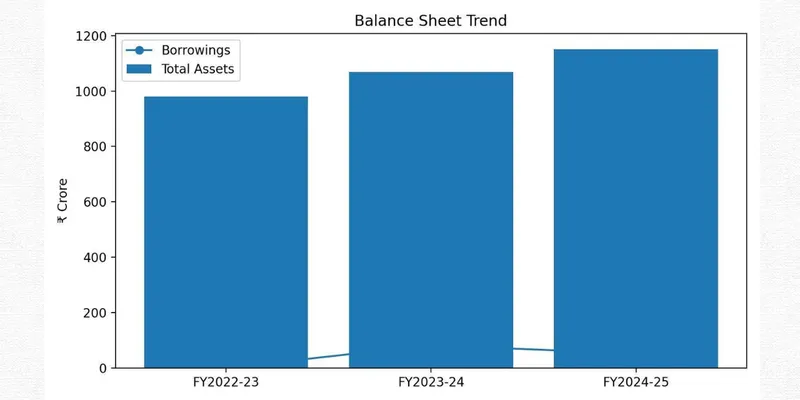
FY2023-24 | 823 | 63 | 1069 | 82 | -138 |
FY2024-25 | 702 | 66 | 1151 | 51 | 129 |
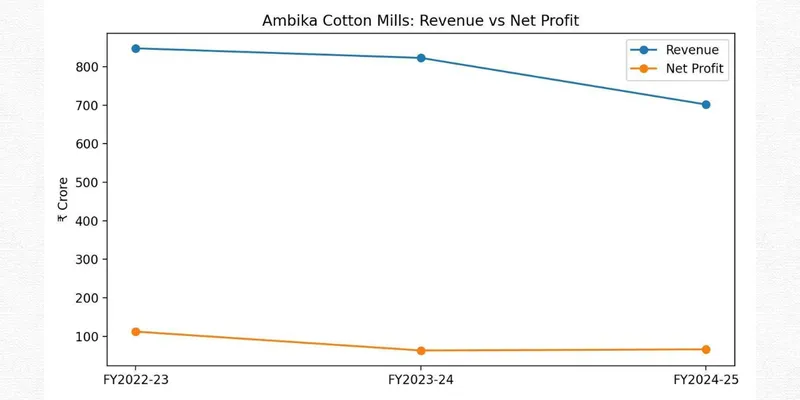
Looking at the income statement, revenue dropped to ₹702 crore by FY2024-25 from ₹848 crore two years earlier, mainly due to lower selling prices along with reduced customer interest. Net profit took a steep dip - falling from ₹112 crore in FY2022-23 down to ₹63 crore next year - though it edged up afterward to ₹66 crore in the latest period shown. Even so, earnings still hold above zero; just not close to the high levels seen during the strong performance stretch of FY2021-22 through FY2022-23.
Key Ratios and Efficiency
Year | OPM % | Net Margin % | ROCE % | Debt/Equity | Inventory Days |
FY2022-23 | 21 | 13.2 | 21 | 0.0 | 280 |
FY2023-24 | 13 | 7.7 | 11 | 0.1 | 344 |
FY2024-25 | 15 | 9.4 | 11 | 0.06 | 475 |
A drop in profitability stands out: margins fell from 21% down to 15%, with returns on capital also slipping, now at 11% versus a prior 21%. Still, earnings stay positive. Financial strength holds, thanks to minimal debt compared to equity. What raises questions? Stock sits longer - now nearly 475 days, up from 280 - a shift that ties up funds and slows operations.
5. Key Insights And Interpretation
Strengths
- Strong financial position
The company operates with zero or very low debt, giving high financial stability and low risk.
Markets Mojo
- Consistent profitability & cash flows
Stable operating margins (~14%) and strong cash generation show good cost control.
Markets Mojo
- Premium product positioning
Known for high-quality compact cotton yarn, especially for export markets.
Indian Share Tips
2. Weaknesses
1. Declining return ratios (ROE, ROCE)
ROE (~6–7%) and ROCE declining → inefficient use of capital.
Markets Mojo +1
2. Low growth business
Sales growth ~4% CAGR → indicates mature, slow-growth company.
Markets Mojo
3. Revenue and profit volatility
Fluctuations in quarterly performance due to industry cycles.
Trendlyne.com
3. Risk Factors / Threats
1. Raw material price volatility
Cotton prices fluctuate due to global supply, weather, and demand → directly impacts margins.
Markets Mojo
2. Cyclical textile industry
Demand depends on global economic conditions and fashion cycles.
Markets Mojo
3. Global competition
Competition from countries like Bangladesh, Vietnam → pricing pressure.
Markets Mojo
4. Future Outlook
Positive Outlook:
Stable business model with strong balance sheet → downside protection
Potential benefit if textile demand recovers globally
Margin improvement possible through cost efficiency
Attractive valuation may lead to re-rating if growth improves
Negative / Cautious Outlook:
Growth likely to remain moderate (not high-growth stock)
Profitability depends heavily on cotton prices & export demand
Continuous decline in ROE may reduce investor confidence
6. Conclusion
Despite present challenges, Ambika Cotton Mills holds steady ground thanks to seasoned leadership and a focused market role. Its financial foundation stays intact, mainly because of cautious borrowing habits and operational consistency. Right now, profits are below earlier highs - yet the core structure shows resilience. For those eyeing durable players in textiles, this firm offers one such option without heavy leverage. Export reliance shapes part of its story, making global demand shifts relevant.
7. References
Ambika Cotton Mills Limited. (2024). Annual report 2023–24. Retrieved from https://www.ambikacottonmills.com
MarketsMojo. (2025). Ambika Cotton Mills Ltd: Result analysis and financial performance. Retrieved from https://www.marketsmojo.com
Trendlyne. (2025). Ambika Cotton Mills Ltd: SWOT analysis and financial metrics. Retrieved from https://trendlyne.com
Screener. (2025). Ambika Cotton Mills Ltd financial statements and ratios. Retrieved from https://www.screener.in