Air Quality Monitoring Market to Reach $11.62B by 2034
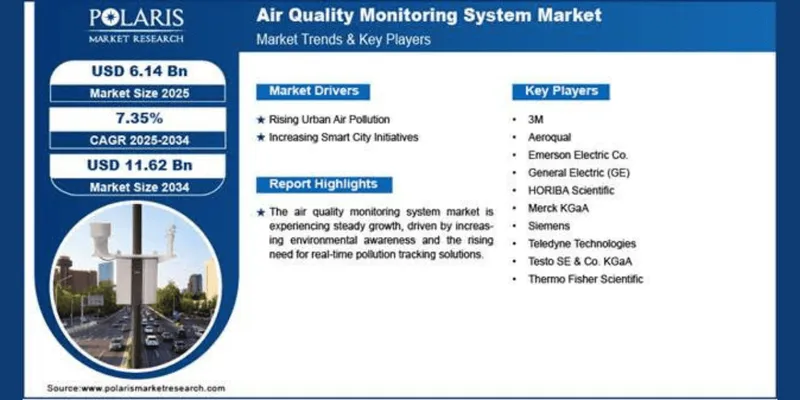
Rising pollution awareness, AI-driven analytics, and smart city initiatives fuel strong global demand for air quality monitoring systems.
The global air quality monitoring system market is set for robust expansion, projected to reach USD 11.62 billion by 2034 at a 7.35% CAGR, according to Polaris Market Research. With environmental concerns and urban pollution on the rise, advanced monitoring solutions are becoming vital for healthier, smarter, and more sustainable living.
Clean air is fundamental to good health — yet, as global pollution levels escalate, maintaining it has become a growing challenge. Air quality monitoring systems play a crucial role in detecting pollutants, tracking emission levels, and providing real-time data about the air we breathe. From crowded cities and industrial zones to schools and residential spaces, these systems empower individuals and policymakers alike to identify pollution sources, take informed actions, and protect public health. Monitoring air quality today isn’t just about technology — it’s about designing a cleaner, healthier future for all.
According to Polaris Market Research, the global air quality monitoring system market stood at USD 5.73 billion in 2024 and is forecasted to grow at a CAGR of 7.35% from 2025 to 2034, reaching USD 11.62 billion by 2034. This growth is fueled by increasing awareness of indoor air quality, technological innovation, urbanization, and government-backed smart city initiatives.
What Is an Air Quality Monitoring System?
An air quality monitoring system is a device or network designed to detect and measure concentrations of harmful gases and airborne particles. These include carbon monoxide (CO), nitrogen dioxide (NO₂), ozone (O₃), sulfur dioxide (SO₂), volatile organic compounds (VOCs), and particulate matter such as PM2.5 and PM10.
By generating real-time data, these systems guide environmental management, support regulatory compliance, and help implement pollution control measures for cleaner, safer air.
Major Types of Air Quality Monitoring Systems
1. Indoor Air Quality Monitoring Systems
Used in homes, offices, schools, and hospitals, these systems detect indoor contaminants like CO₂, CO, VOCs, and PM2.5. They help identify pollution sources such as inadequate ventilation, chemical cleaners, or building materials, ensuring healthier indoor environments.
2. Outdoor Air Quality Monitoring Systems
Deployed in urban centers, highways, and industrial zones, these stations measure ambient air pollutants including NO₂, SO₂, O₃, and particulate matter. The collected data aids regulators, researchers, and policymakers in tracking pollution trends and implementing air quality standards.
3. Portable and Wearable Air Quality Monitors
Compact, battery-powered, and mobile, these monitors allow individual users or field researchers to track air quality in real time. Ideal for outdoor workers and communities, they enable personalized pollution exposure assessment and contribute to community-driven air monitoring.
4. Smart and IoT-Enabled Air Quality Monitoring Systems
These systems integrate with the Internet of Things (IoT) to collect, analyze, and transmit air quality data through cloud-based platforms and mobile apps. IoT connectivity enables predictive analysis, automated alerts, and supports smart city development, offering valuable insights for both consumers and municipal authorities.
How Artificial Intelligence Is Transforming Air Quality Monitoring
The integration of AI and machine learning is revolutionizing how air quality is measured and managed:
- Data Precision: AI algorithms process massive data sets to enhance pollution prediction accuracy.
- Source Identification: Machine learning models pinpoint pollution sources and trends, enabling faster interventions.
- Automated Operations: AI streamlines real-time data correction and anomaly detection in sensor readings.
- Smart Connectivity: The convergence of AI and IoT enables predictive maintenance and continuous air monitoring.
- Policy Support: AI-driven analytics empower governments and industries to make data-informed environmental decisions.
Emerging Trends and Technologies
Next-generation monitoring systems are becoming smarter, smaller, and more integrated. Innovations like low-cost miniaturized sensors, satellite-based monitoring, and cloud-enabled analytics are improving precision and expanding reach. Real-time visualization through mobile apps and dashboards allows instant access to air quality data, making it easier for individuals and institutions to track, forecast, and act on pollution information.
Final Outlook
As environmental awareness grows, the air quality monitoring system market continues to expand globally. Advances in AI, IoT, and sensor technology are driving better accuracy, affordability, and accessibility. Beyond its technological value, this evolution underscores a shared global mission — to create cleaner air, healthier communities, and a sustainable planet for future generations.