AI in the Textile Industry: ITAMMA and SITRA Conference Highlights Practical Applications Across the Value Chain
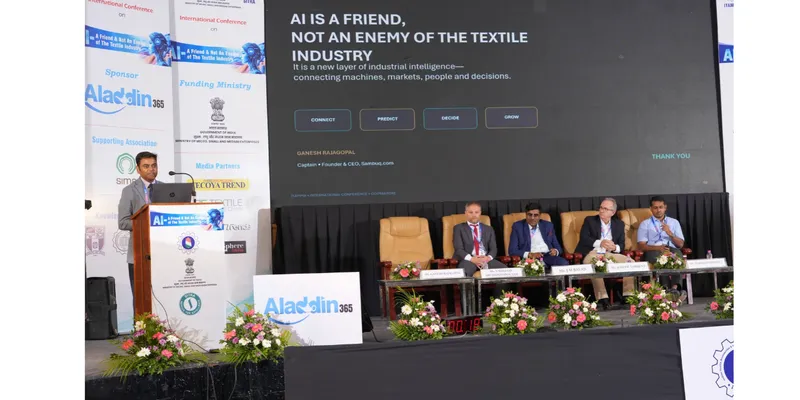
The 25 September 2026 conference in Coimbatore examined AI applications in spinning, weaving, quality control, predictive maintenance, sustainability and enterprise decision-making, with speakers emphasising measurable results, reliable data and workforce skills.
Artificial intelligence (AI) is creating opportunities to improve productivity, quality control, resource efficiency and decision-making across the textile value chain. These applications were discussed at “AI – A Friend and Not an Enemy of the Textile Industry”, a conference organised by the Indian Textile Accessories and Machinery Manufacturers’ Association (ITAMMA) and the South India Textile Research Association (SITRA) on 25 September 2026 at the SITRA Auditorium in Coimbatore.
The programme brought together representatives from technology companies, textile manufacturers, research institutions, academia and industry associations. Discussions covered applications ranging from fibre selection and spinning operations to fabric inspection, supply-chain management, digital marketing and technical textiles. A recurring theme was that successful AI adoption depends on identifying specific business problems, using reliable data and retaining the judgement of experienced textile professionals.
Opening Session: Connecting Technology with Textile Industry Needs
Om Prakash Mantry: Addressing Supply-Chain Challenges
ITAMMA President Om Prakash Mantry introduced the conference theme through the challenges of a fragmented textile supply chain. His welcome address covered traceability, planning using market information, waste reduction and collaboration between people and technology.
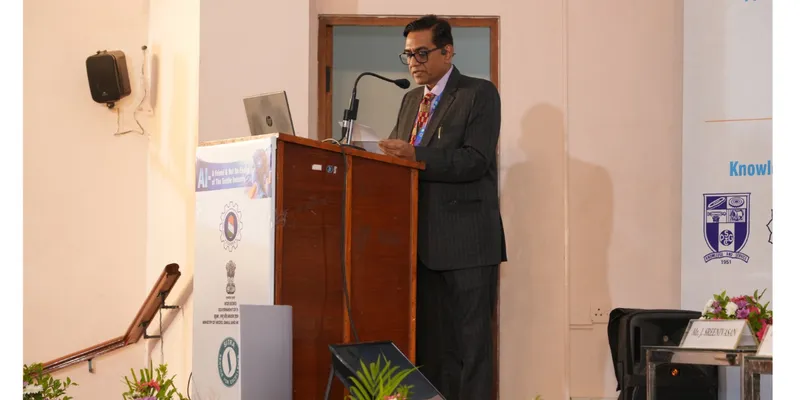
He positioned AI as a potential means of improving competitiveness and sustainability, supported by industry associations and government initiatives.
Vishal Masand: Supporting Machinery and Accessory Manufacturers
ITAMMA Vice President Vishal Masand outlined the association’s services to textile machinery and accessory manufacturers. These include knowledge sharing, digital information, research and development, lean manufacturing, quality initiatives, industry–academic connections, exhibitions and export opportunities.
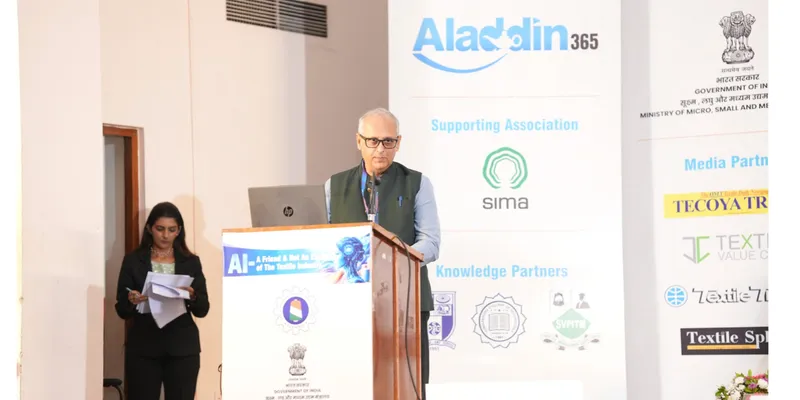
The presentation highlighted the role of collective industry support in helping smaller companies access expertise and develop their capabilities.
J Sreenivasan: Using Research and Testing Infrastructure
SITRA's Head of Liaison and Consultancy, J Sreenivasan, presented the organisation's research, testing, consultancy and training capabilities. The areas covered included spinning, weaving, knitting, physical and chemical testing, productivity and cost comparisons, machinery calibration, utility audits and medical textiles.
The discussion highlighted how mills can use research and testing infrastructure to diagnose operational problems before committing resources to new solutions.
Rajeswaran Sundarraj and Dr Prakash Vasudevan
Rajeswaran Sundarraj, ITAMMA's Honorary Treasurer and Managing Director of Naren Group of Companies, outlined the conference programme, which progressed from keynote and government addresses to international technology presentations, Indian industry experiences, spinning applications, academic discussions and ITAMMA's digital transformation initiatives.
In his concluding remarks during the inaugural session, SITRA Director Dr Prakash Vasudevan stressed the importance of trained personnel, reliable data and collaboration in effective AI adoption. He connected these requirements with forecasting, inventory and supply-chain management, sustainability and resource efficiency, while emphasising the continued role of skilled judgement.
Keynote and Government Address
Sridhar Chitraju: AI Applications Across the Textile Value Chain
Sridhar Chitraju, introduced as Director and Chief Technology Officer for the CTO Centre of Excellence at Kyndryl, discussed AI applications across the textile value chain, from farming and fibre production to manufacturing, fashion and overseas markets.
His examples covered:
- Agriculture and fibre: Supporting pest management, irrigation decisions, fibre grading and blending.
- Manufacturing operations: Improving process control, maintenance and quality inspection.
- Dyeing: Supporting dye recipe decisions.
- Product development: Connecting product development with demand information.
- Operational efficiency: Identifying avoidable losses that can become significant when repeated across large-scale mill operations.
Chitraju distinguished between machine learning, computer vision, generative AI and systems that recommend or coordinate actions. He identified usable information from machines, laboratories and operators as a common requirement across these technologies.
He recommended beginning with a specific process or production line, establishing a performance baseline and conducting a focused pilot before expanding an application. Collaboration among mills, technology providers, ITAMMA and SITRA could also help develop shared expertise and relevant datasets.
The approach retained experienced personnel as the decision-makers responsible for assessing recommendations and determining the appropriate action.
Mercy Epao: Government Support for Textile and MSME Development
Mercy Epao, Joint Secretary for SME in the Ministry of MSME, discussed formalisation, access to finance, quality improvement, innovation, skills and exports. Her address connected technology adoption with broader business development and participation in government support programmes.
Initiatives mentioned included Udyam and Udyam Assist, ZED, incubation and design support, intellectual property assistance, credit guarantees, procurement and marketing assistance, international cooperation, technology centres and programmes under RAMP. She also addressed the inclusion of women and disadvantaged entrepreneur groups.
The presentation encouraged businesses to consider available institutional support when planning modernisation. Scheme amounts, eligibility conditions, thresholds and application dates should be confirmed with the responsible ministry before businesses rely on them.
Global Technology Perspectives on Intelligent Textile Manufacturing
The international technology session, moderated by J M Balaji of LRT, focused on the relationship between people, machinery and trustworthy data. The discussion encouraged mills to identify specific operational problems while retaining the knowledge of experienced employees.
Josep Torrent: From Machine Monitoring to Intelligent Spinning Mills
Josep Torrent, Managing Director of Pinter's Indian operations, discussed machine monitoring as a foundation for more informed production decisions.
Examples included production sequencing, balancing quality and delivery requirements, machine availability, mill-data queries and speed optimisation. The presentation distinguished conventional automation and fixed-rule alarms from systems that learn from data or recommend actions.
Some applications were presented as development directions rather than capabilities already deployed universally across mills.
Vasileios Archontopoulos: Building a Connected Textile Value Chain
The Uster Technologies representative discussed five areas of opportunity: material intelligence, product passport verification, factory assistance, supply-chain coordination and circularity.
He identified raw-material decisions and factory performance as practical starting points for digital applications. Connected quality information can help mills trace defects to their origins and prevent recurrence rather than relying only on final-stage inspection.
Archontopoulos also emphasised the need to calibrate models to individual mills and operating conditions. Changes in machinery, materials or processes may require adjustments or retraining, as a model's performance cannot automatically be assumed to transfer across different environments.
Jaivardhan Thirupathi: Automation and Traceability
Jaivardhan Thirupathi of CountAI and Indo Texnology presented on behalf of Harshavardhan Thirupathi. The presentation examined automation beyond workforce reduction, focusing on consistent handling, packing records, traceability and preventing product mix-ups.
Digital records of lots, cones, bags, images and weights can connect production with dispatch operations. The discussion also covered machine-vision inspection in knitting and weaving.
The company profile identifies Jaivardhan as Co-Founder and Customer Success Officer; his surname was not confirmed in the reviewed material.
Enterprise Intelligence and AI-Driven Decision-Making
Ganesh Rajagopal: Connecting Operational and Business Information
Ganesh Rajagopal, Founder, President and CEO of Sambuq.com, discussed the use of AI at the enterprise level, linking production information with finance, procurement, markets, policy and research.
He introduced the OPERA framework — Observe, Predict, Enable, Recommend and Act — as a sequence for converting information into decisions.
Rajagopal recommended adding intelligence to existing systems rather than assuming that every business must replace its enterprise resource planning (ERP) platform. He emphasised manageable starting points, staff training and clear ownership of decisions.
The presentation also connected these ideas with ITAMMA's digitalisation work and Smart Data Clinic.
During the question session, Harshavardhan Thirupathi discussed practical entry points for AI. He argued that companies do not need to wait until an entire factory is digitised before beginning. Existing production, finance and sales records can support initial projects, provided the trials address defined problems and use measurable results.
Global Panel: Return on Investment and Workforce Readiness
The global panel returned to topics including return on investment, raw-material costs, defect detection, predictive maintenance and changes in working practices.
Participants favoured targeted applications with a clear performance baseline. They also highlighted employee confidence and management commitment as factors influencing whether a technology becomes part of daily operations.
The discussion did not establish that every mill should become fully autonomous. Instead, it supported combining automation with textile expertise, checking recommendations and building data continuously as applications demonstrate their value.
Sustainability and traceability were discussed as both commercial capabilities and resource-management concerns.
National Industry Panel: Practical Applications Across Textile Operations
The national industry panel examined applications in fibre mixing, spinning, knitting inspection, maintenance, dye recipes, design, demand forecasting, inventory and recycling. The following contributions were part of a moderated discussion rather than separate formal presentations.
Suryadeb Mukherjee: AI Across Textile Operations
The Gherzi Consulting Engineers representative introduced applications across manufacturing and supply-chain functions. His discussion addressed cost pressures, shorter product cycles, workforce skills and sustainability.
He also highlighted practical considerations in machine-vision systems, including lighting conditions, data quality, false detections and repeatability.
Sanjay Jain: Commercial Value and Workforce Skills
Sanjay Jain, Managing Director of TT Ltd, discussed the financial constraints textile companies face when investing in technology.
He identified potential applications in design, product imagery, spreadsheets, sales and stock planning, while questioning expensive solutions whose returns are unclear. His contribution stressed the importance of domain knowledge, effective questions and staff training when translating AI output into business decisions.
Srinivas Naik: Water, Energy and Sustainability
The Arvind sustainability representative connected sensor and recipe data with production scheduling, quality and resource consumption.
Planning decisions need to account for water and steam capacity alongside delivery deadlines. The discussion also covered traceability, circular design, recycling and sustainability reporting.
Naik cautioned that the energy and water footprint of AI infrastructure should be included when assessing its overall environmental benefits.
Jayant Daga: Export Research and Digital Marketing
The Krios Global representative discussed accessible applications for smaller exporters, including researching markets and buyers, preparing product information, tailoring sales pitches and creating garment mock-ups or campaign material from fabric.
These tools can reduce preparation time, but the outputs still require informed prompts and review by the user.
Laxmikant Rathi: Machine Integration and Technical Textiles
The ICC Pune representative identified closed machine interfaces as an obstacle to combining information across a mill. He emphasised the importance of considering data accessibility when purchasing equipment.
His contribution also covered contamination control and the design requirements of technical textiles, where properties such as thermal performance, acoustic behaviour, flame resistance, stretch and moisture management may need to be considered together.
AI in Spinning Operational Excellence
Devadas Dhamodaraswamy: Applying AI to Spinning Operations
Devadas Dhamodaraswamy, President Director of Texcoms Worldwide, presented “Leveraging AI in Spinning Operational Excellence”, focusing on how ERP information can support operational decisions in spinning mills.
His proposed approach connected data collection, baseline measurement, modelling, ranked recommendations, financial evaluation and managerial approval. Feedback on the results would then inform subsequent decisions.
The examples addressed three areas with direct economic relevance: raw-material costs, machine productivity and energy consumption.
Raw-Material Cost Example
One mill example reported the following figures:
- Baseline cost: Rs 159.77 per kg
- Predicted cost: Rs 158.62 per kg
- Achieved cost: Rs 158.94 per kg
- Achieved reduction: Rs 0.83 per kg
These figures were reported in the presentation and were not independently audited savings.
Productivity and Machine Performance
A larger spinning-mill example used production and stoppage information to prioritise frames requiring attention. The available material did not establish a sufficiently clear numerical improvement, so no specific productivity gain was reported.
Energy Consumption Example
Another example reported an energy reduction from approximately 0.827 to 0.820 kWh per kg. The corresponding cost changed from about Rs 6.72 to Rs 6.66 per kg.
The commercial significance of these changes depends on production volume, electricity tariffs and whether the performance can be sustained.
Proposed Implementation Process
The suggested rollout began with agreement on an operational problem and the collection of historical ERP records. Subsequent steps involved cleaning the data, calibrating the model with staff, approving recommended changes and recording decisions and outcomes.
Dhamodaraswamy described a short initial implementation period, but this was his proposed approach rather than a guaranteed deployment timetable for every mill.
The session also referred to Aladdin365 as a textile professional networking platform. Product and service references in the conference report identify the subjects discussed and do not constitute endorsements.
Academic Panel: Research, Education and Workforce Development
The academic panel was explicitly conducted as a discussion without individual slide presentations. Moderated by P T Muralidharan of Vetal, it explored practical research, industrial problems, education and skills development.
Dr R Guruprasad: Textile Research and Medical Textiles
The SITRA medical-textiles representative discussed the relationship between AI, computational methods, testing data and the prediction of material properties.
He addressed sensor-integrated textile applications and the potential of laboratory archives to identify defects and their likely causes. His proposed progression was to develop an affordable offline tool before moving towards online industrial applications.
Dr M Saravanan: Interdisciplinary Education and Industry Projects
Dr M Saravanan, Head of Textile Technology at Kumaraguru College of Technology, described laboratory facilities, internships and projects bringing textile students together with specialists in computing, electronics and mechatronics.
He discussed digital design and analytics as useful skills, while emphasising industry mentorship and responsible judgement.
Lalitha Lakshmi: Digital Design, Creativity and Textile Heritage
The SVPITM representative was asked about digital prototyping and reducing sampling waste. The reviewed material contained a gap in the caption record for part of her initial response, so the missing details could not be reconstructed reliably.
In later contributions, she discussed the potential of Indian textile heritage and design. She also cautioned that dependence on generated assignments could weaken students' understanding and creativity.
Dr B Vinod: Robotics and Responsible Automation
Dr B Vinod, Head of Robotics and Automation Engineering at PSG College of Technology, discussed the transition from manual records to sensor-based monitoring using temperature, vibration and acoustic information.
Simulation and digital twins were presented as methods for understanding bottlenecks. His later remarks raised concerns about dependence on technology and autonomous physical systems; these were expressed as concerns about future use rather than established outcomes of textile deployments.
ITAMMA's Digital Transformation and Smart Data Clinic
N D Mhatre: ITAMMA's Digital Journey
ITAMMA Director General Technical N D Mhatre described the association's digital transformation journey since 2022. He contrasted the reach of physical events and printed information with the continuing digital connections among members, technology providers and the wider textile ecosystem.
Ganesh Rajagopal: Industry Intelligence and Data Access
Continuing the joint closing presentation, Rajagopal discussed mobile access to knowledge and the collection, curation and analysis of industry information.
Demonstrations included member geography and trade information, with the longer-term direction moving towards enterprise-specific intelligence. The discussion also covered planned additions; the presentation material did not establish that every mentioned dashboard or data source was already operational.
Dhandayuthapani Chidambaram: Vote of Thanks
Dhandayuthapani Chidambaram, introduced as Managing Director of MAG Solvics and an ITAMMA committee member, delivered the vote of thanks. He acknowledged the sponsor, supporting association, knowledge partners, media partners, moderators, speakers and participants.
Key Takeaways for Textile Businesses
The conference discussions pointed to several practical considerations for companies exploring AI adoption:
- Start with a defined problem: Identify a recurring operational or commercial issue before selecting a technology.
- Establish a baseline: Compare performance before and after implementation to determine whether an application delivers measurable benefits.
- Build on reliable data: Check data accuracy, relevance and accessibility, including information from machines and existing business systems.
- Evaluate costs and benefits: Consider raw materials, quality, downtime, resource consumption, inventory and market response.
- Retain textile expertise: Operators, managers, researchers and students need the skills to assess outputs, identify errors and make responsible decisions.
- Encourage industry–academic collaboration: Shared learning, relevant datasets and focused pilot projects can support the development of applications suited to textile operations.
These conclusions reflect the themes of the conference discussions rather than a formally adopted conference resolution.
The event underscored that AI adoption in textiles involves more than installing new software or automated machinery. Its practical value depends on how effectively companies connect technology with operational knowledge, reliable information, trained personnel and measurable business objectives.