AI Data Center Water and Cooling Compliance Market Projected to Reach USD 35.22 Billion by 2034
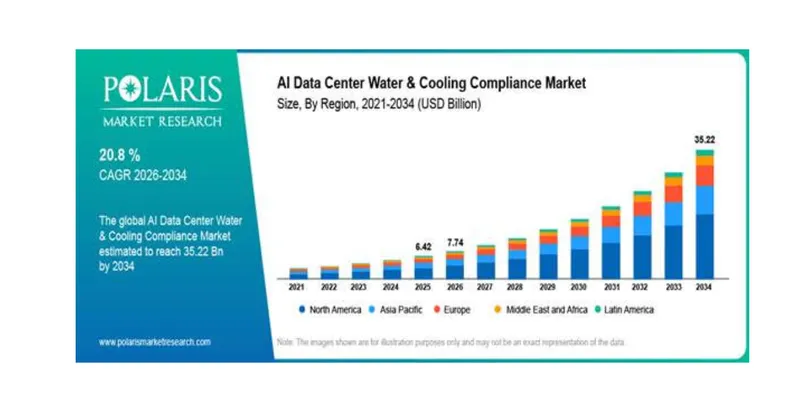
The market is forecast to grow at a CAGR of 20.8% from 2025 to 2034, driven by rising cooling demands from AI infrastructure, water-efficiency requirements and sustainability reporting obligations.
The global AI data center water and cooling compliance market was valued at USD 6.42 billion in 2025 and is projected to reach USD 35.22 billion by 2034, registering a compound annual growth rate (CAGR) of 20.8%, according to Polaris Market Research.
The expansion of artificial intelligence infrastructure is increasing the need for effective heat management and water-use monitoring. As high-density computing systems generate more heat, data center operators are evaluating cooling technologies alongside water availability, regulatory requirements and the need to document resource consumption.
Water Use Becomes a Data Center Design Consideration
AI accelerators generate significant heat at high rack densities, creating challenges for conventional room-cooling systems. Operators are increasingly adopting technologies that capture heat closer to the chip, including direct-to-chip liquid cooling.
However, liquid cooling does not eliminate the need to remove heat from the facility. Operators must select suitable heat-rejection systems, such as dry coolers, chilled-water systems, hybrid cooling arrangements or evaporative cooling towers. Each option has different implications for water consumption, energy use and maintenance.
Regulatory reporting requirements are also increasing the importance of measuring water use. In Europe, data centers with installed IT capacity of 500 kW or more are subject to annual sustainability reporting requirements through the European Database on Data Centres. A 2024 delegated regulation includes water-use reporting, including water usage effectiveness (WUE).
Singapore has established a WUE benchmark of 2.0 cubic metres per megawatt-hour (m³/MWh) or lower. These developments are making water efficiency an increasingly important consideration during data center planning and approval.
Compliance Creates Opportunities Beyond Cooling Equipment
The market extends beyond cooling hardware to include metering, sensors, analytics, water treatment, control systems and compliance services.
Although global hyperscalers can standardise their computing equipment, water and cooling requirements vary by location according to climate, water quality, utility capacity and permitting conditions. Operators therefore need site-specific assessments, consistent data definitions and support for regulatory reporting.
According to the supplied market analysis, metering, sensors and analytics are forecast to be the fastest-growing solution layer, with a CAGR of 22.85%. Cooling and heat-rejection equipment accounted for the largest market share in 2025, at 47.36%.
Other projected growth areas include:
- Zero-water and dry cooling: Forecast CAGR of 24.63%.
- Direct-to-chip liquid cooling: Forecast CAGR of 26.35%.
These segments reflect the industry's focus on managing heat while addressing water availability and operational efficiency.
Retrofit Costs Remain a Challenge
Implementing advanced cooling and water-management systems can require substantial upfront investment. Direct-to-chip cooling, coolant distribution units and water-recycling infrastructure may require major modifications at existing facilities.
Retrofitting legacy data centers can involve new pipework, leak detection, filtration systems, controls and changes to heat-rejection capacity. Using treated or reclaimed water also introduces water-quality considerations, including corrosion, scaling and the need for ongoing monitoring.
Operators must weigh these investments against potential permitting delays, regulatory requirements and scrutiny from local communities over water consumption.
Regional Market Dynamics
North America led the market in 2025 with a 39.27% share. The United States accounted for 72.47% of the region's share, according to the supplied analysis, as hyperscale data center development increasingly intersects with local utility constraints.
Europe held a 24.18% market share, supported by sustainability reporting requirements and regulatory scrutiny.
Asia Pacific is projected to be the fastest-growing region, with a CAGR of 23.79%. Water-efficiency expectations and policy developments in markets such as Singapore and Malaysia are contributing to the region's growth outlook.
Latin America is forecast to grow at a CAGR of 20.61%. In the absence of a region-wide WUE requirement, hyperscaler standards and project-financing criteria are important influences on water-management practices.
The Middle East and Africa accounted for 3.14% of the market in 2025. Water scarcity makes the region a potential area of interest for dry cooling and zero-water cooling approaches.
Competitive Landscape: Focus Shifts to Verified Performance
Competition spans thermal-management equipment, liquid-cooling technologies, water treatment and reuse solutions.
Vertiv introduced its CoolChip CDU 2300 in May 2026. Companies including CoolIT, LiquidStack, Submer and Iceotope focus on direct-to-chip and immersion cooling technologies, while Veolia, Ecolab and Xylem operate in water treatment and reuse.
Hyperscale operators are also exploring approaches to reduce cooling-related water consumption. Microsoft has described an AI-optimised data center design that uses no water for cooling. Amazon Web Services plans to quadruple its 24 recycled-water-cooled data centers by 2030.
These developments highlight a shift in market priorities towards measurable water-use outcomes, energy efficiency and compliance, alongside cooling capacity.
Integrated Water and Cooling Planning Expected to Expand
Water management and cooling design are increasingly being considered together. Continuous WUE monitoring, automated compliance reporting and AI-assisted cooling optimisation are expected to become more prominent in data center operations.
Reclaimed-water systems and zero-water cooling designs may also gain wider adoption, although implementation will depend on site conditions, infrastructure and investment requirements.
The supplied analysis projects a CAGR of 18.35% for guideline-driven frameworks that link incentives and permits to water-efficiency goals. A September 2026 report from the Pacific Institute also called for standardised water-use reporting.
However, capital requirements, legacy infrastructure and differences between locations are likely to influence the pace of adoption. No single cooling architecture is suitable for every data center.
Outlook for the Market
The projected expansion of the AI data center water and cooling compliance market reflects the growing importance of documenting resource use alongside computing performance.
Operators and suppliers that can demonstrate measurable water performance and meet applicable reporting requirements may be better positioned to address permitting requirements and community concerns. As AI infrastructure expands, water availability and cooling efficiency are becoming increasingly important factors in data center design and operation.