AI Circular Economy Conference 2026 Highlights AI Role in Circular Materials
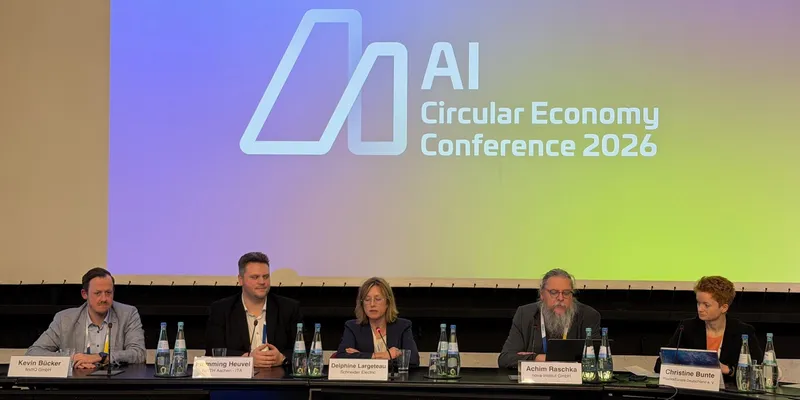
The AI Circular Economy Conference 2026, organised by the nova-Institute, brought together 116 participants from 15 countries in Cologne and online to examine how artificial intelligence is supporting transformation in the chemical and materials industries. Over two days, industry leaders, researchers, start-ups and investors discussed the role of digital intelligence in developing circular value chains based on renewable carbon.
The conference programme included 24 presentations and several panel discussions. Speakers from industry, research institutions, start-ups and the investment community examined how AI technologies are being integrated into circular material systems and industrial processes. Discussions focused on how artificial intelligence is moving from experimental development toward industrial implementation within the circular economy.
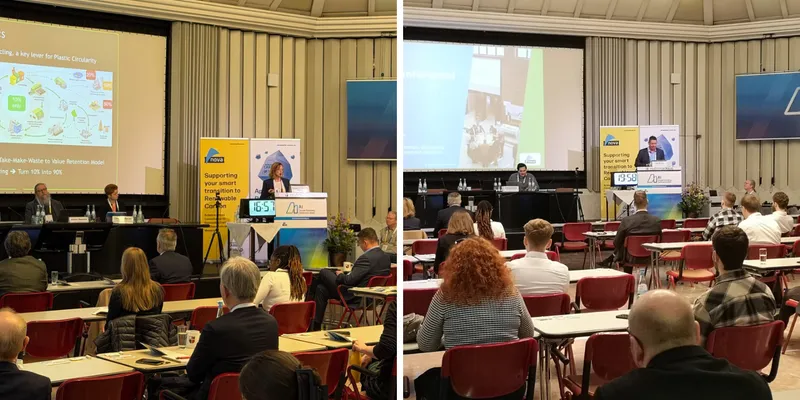
Intersection of Artificial Intelligence and Circular Economy
According to Lars Börger, the conference theme was described as:
“When two bubbles meet, they collide. In that moment of collision, something new can emerge, often something bigger and more powerful than either bubble on its own.”
Artificial intelligence and the circular economy are both rapidly developing fields. The conference therefore examined not only technological developments but also collaboration models, open data environments and interdisciplinary cooperation between software developers, materials scientists, industrial companies and policy specialists.
Conference Structure and Key Themes
The programme was organised into five thematic sections, each addressing different AI applications in the circular economy. Presentations highlighted how artificial intelligence is being applied throughout the circular value chain, including production processes, materials development, recycling technologies, resource management and market decision-making.
Examples presented by companies, start-ups and research institutions included projects and tools developed by organisations such as Covestro, Schneider Electric, ExoMatter, Volkswagen and RWTH Aachen University, along with investment initiatives such as the European Circular Bioeconomy Fund.
These examples illustrated how AI technologies are being used for applications including digital twins, predictive maintenance and real-time process optimisation in manufacturing. Machine learning methods are also being used to accelerate the discovery of new catalysts, polymers and bio-based materials.
Additional technologies discussed during the conference included AI-powered sorting systems, hyperspectral imaging and advanced data platforms designed to analyse complex waste streams, improve feedstock quality and enable higher-value recycling processes.
Across the presentations, speakers emphasised that artificial intelligence alone is not sufficient to drive change. Effective use of AI requires high-quality data, industrial knowledge and digital infrastructure to support decision-making, process optimisation and the development of circular material systems.
AI and the Renewable Carbon Economy
A key conclusion from the conference sessions was the increasing role of artificial intelligence as an enabling technology in the renewable carbon economy. AI tools can support improvements in productivity, sustainability and competitiveness in the chemical and materials sectors by accelerating material discovery, enabling digital twins, supporting recycling technologies and optimising supply chains.
These capabilities can contribute to the transition from fossil-based value chains to circular systems that rely on biomass, captured CO₂ and recycled materials.
Partners and Supporting Organisations
The AI Circular Economy Conference 2026 was supported by a network of partners and organisations involved in renewable carbon and circular materials initiatives. Strategic partners included CLIB – Cluster Industrial Biotechnology, IBB Netzwerk GmbH, Chemie-Cluster Bayern, C.A.R.M.E.N. e.V., the Renewable Carbon Initiative, kunststoffland NRW, the Institute for Textile Technology (ITA) of RWTH Aachen University, the German AI Association and CO₂ Value Europe.
The event was also supported by several international media partners that reported on developments discussed during the conference. These included Renewable Carbon News, Renewable Carbon Plastics Magazine, Plasticker, PETplanet, PIE – Plastics Information Europe, K-Zeitung, CHEManager, European Biotechnology Magazine, Circular Economy, Brazilian Plastics – Blog do Plástico, Plattform Life Sciences, Circular Rubber Platform, GermanTechJobs and forum future economy.
Upcoming Events
Discussions on artificial intelligence and circular materials will continue at several upcoming conferences organised by the nova-Institute. These include the Carbon Capture & Utilisation Conference 2026 scheduled for 28–29 April 2026 in Cologne, the Renewable Materials Conference 2026 taking place from 22–24 September 2026 in Siegburg/Cologne, and the Advanced Recycling Conference 2026 on 17–18 November in Cologne.
These events will continue discussions on how artificial intelligence, data infrastructures and digital tools are influencing innovation, resource efficiency and circular material systems in industry.