Agrotech Textiles Market Size 2026: USD 15 Billion Opportunity with 25–40% Yield Gains
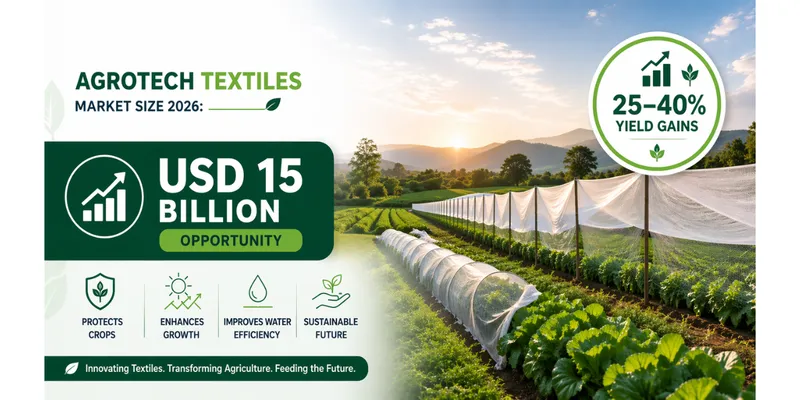
The Agrotech Textiles market has become one of the fastest-growing segments in modern agriculture, with measurable performance improvements in yield, water efficiency, and cost reduction. The market is shifting from traditional farming support materials to advanced, performance-based agricultural infrastructure.
According to recent industry insights by Dataintelo in 2023, the global market size was approximately USD 11.8 billion, and it is projected to reach around USD 15.1 billion by 2026, reflecting a steady CAGR of 8.3% to 8.6% annually. This consistent growth shows how agriculture is increasingly adopting textile-based solutions for productivity and sustainability.
2026 Market Size and Growth Metrics
The global agrotech textiles market reached approximately USD 11.8 billion in 2023, and is projected to grow to USD 17.6 billion by 2028, reflecting a compound annual growth rate (CAGR) of 8.3%.
Year-by-Year Market Growth:
Year | Market Size (USD Billion) | Growth Rate (%) |
2022 | 10.9 | — |
2023 | 11.8 | 8.2% |
2024 | 12.8 | 8.5% |
2025 | 13.9 | 8.6% |
2026 | 15.1 (est.) | 8.6% |
Between 2022 and 2026, the market added nearly USD 4.2 billion in value, demonstrating strong demand consistency.
5 Data-Backed Reasons Driving Market Growth
1. Rising Demand for Crop Yield Efficiency (+25–40%)
Agrotech textiles such as shade nets and mulch mats can increase crop yields by 25% to 40%, depending on crop type and climatic conditions. Farmers adopting these solutions have reported ROI periods of just 1.5 to 2.5 years.
2. Expansion of Protected Cultivation (↑ 12% annually)
Protected farming areas (greenhouses, polyhouses) are expanding at 12% CAGR globally, directly increasing demand for:
• Shade nets (usage up by 18% since 2021)
• Anti-insect nets (growth of 15% YoY)
3. Water Conservation Impact (Savings up to 50%)
Agrotech textiles used in irrigation systems can reduce water usage by 30% to 50%, a crucial advantage in regions facing water scarcity. Drip irrigation fabrics alone have seen a 20% adoption increase since 2022.
4. Climate Change Mitigation Adoption (+35% usage)
With extreme weather events increasing by ~20% globally since 2020, farmers are increasingly adopting protective textiles. Usage of frost protection fabrics rose by 35% between 2021 and 2025.
5. Government Subsidies Covering 40–60% Costs
In countries like India and China, subsidies for agrotech textiles cover 40% to 60% of installation costs, significantly accelerating adoption rates.
Product Segment Breakdown
Agrotech textiles are divided into several key product categories with measurable market shares. Shade nets dominate with 34% of total market share, followed by mulch mats at 22%, anti-hail nets at 14%, agro-support nets at 18%, and other specialized products at 12%.
Shade nets remain the most widely used due to their affordability, costing only USD 0.30 to USD 0.80 per square meter, making them accessible to a large farmer base.
Regional Insights with Numbers
Asia-Pacific leads the global market with a 48% share, valued at approximately USD 6.7 billion in 2025–2026 projections, and growing at a CAGR of 9.1%, the highest globally.
Europe holds a 22% share, driven by sustainability regulations and a 28% rise in organic farming since 2021. North America accounts for 19% share, where smart textile adoption has grown at 16% annually, particularly in precision agriculture systems.
Performance Comparison: Traditional vs Agrotech Farming
The impact of agrotech textiles is clearly measurable when compared to traditional farming systems. Average crop yield increases from 2.5 tons per acre in conventional farming to 3.5– 4.0 tons per acre using textiles, representing up to a 40% improvement.
Water consumption reduces from a baseline of 100% in traditional farming to 60%–70% with textile systems, saving up to 40% water per cycle. Pest-related losses also decline significantly from 20%–30% in conventional systems to 5%–10% in protected farming, a reduction of nearly 70%.
Financially, farmers investing USD 1,000–2,000 per hectare typically achieve profit increases of 20%–35% annually, with a payback period of 1.5 to 2.5 years.
Key Statistics at a Glance
• Market size (2023): USD 11.8 billion
• Market size (2026): USD 15.1 billion
• CAGR: 8.3%–8.6%
• Yield increase: 25%–40%
• Water savings: 30%–50%
• Pest loss reduction: up to 70%
• Shade net share: 34%
• Asia-Pacific share: 48%
• Subsidy coverage: 40%–60%
• ROI period: 1.5–2.5 years
• Protected farming growth: 12% annually
Future Forecast: 2026–2030 Projections
• Market size by 2030: USD 21.5 billion
• Expected CAGR: 8.5%
• Smart textile penetration: 25%
• Biodegradable product share: 20%+
• Average farm adoption globally: 45% (up from 28% in 2023)
The industry is expected to add over USD 6 billion in incremental value between 2026 and 2030.
Conclusion
The agrotech textiles industry is growing steadily, with the market expanding from USD 10.9 billion in 2022 to a projected USD 15.1 billion in 2026. Strong annual growth of 8%+, combined with measurable farm-level improvements such as 40% higher yields, 50% water savings, and up to 70% reduction in crop losses, demonstrates its economic and agricultural value.
With increasing subsidies of up to 60%, rising climate pressures, and rapid adoption in Asia Pacific, agrotech textiles are becoming a core component of modern farming systems worldwide. The data clearly shows that this is not just a trend but a long-term transformation in agricultural productivity.
Read A Full Report: https://dataintelo.com/report/agrotech-textiles-market-report