Agro Textiles Market Outlook 2026: 12 Data-Driven Insights Transforming Modern Agriculture
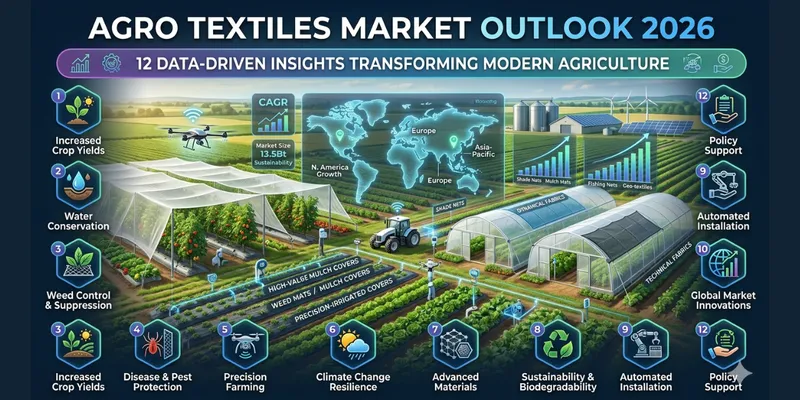
The global agro textiles industry is rapidly becoming a cornerstone of modern agriculture, helping farmers improve crop yield, reduce water usage, and protect crops against extreme weather conditions. Agro textiles are increasingly adopted across greenhouse farming, horticulture, floriculture, aquaculture, and soil protection applications due to measurable improvements in productivity and sustainability.
According to industry analysis by Dataintelo in 2025, the global agro textiles market was valued at approximately USD 11.8 billion and is projected to surpass USD 18.6 billion by 2032, expanding at a CAGR of 6.7% during 2025–2032. Rising food demand, climate uncertainty, and precision farming technologies are accelerating adoption across both developed and emerging economies.
Key Statistics at a Glance
Metric | Value |
Global Agro Textiles Market Size (2025) | USD 11.8 Billion |
Forecast Market Size (2032) | USD 18.6 Billion |
CAGR (2025–2032) | 6.7% |
Shade Net Market Share | 31% |
Greenhouse Farming Growth (2020–2025) | 42% |
Average Crop Yield Increase Using Agro Textiles | 20%–60% |
Water Consumption Reduction | Up to 35% |
UV Protection Efficiency | 90%–95% |
Asia Pacific Market Share (2025) | 38% |
Polypropylene Material Share | 47% |
Soil Erosion Reduction Using Mulch Mats | Up to 70% |
Pest Damage Reduction | 25%–40% |
What Are Agro Textiles?
Agro textiles are specialized technical textile products designed for agricultural applications. These materials are manufactured using synthetic fibers such as polypropylene, polyethylene, nylon, and polyester.
They are primarily used in:
• Crop protection
• Shade management
• Soil stabilization
• Weed control
• Water conservation
• Greenhouse covering
• Aquaculture systems
Between 2021 and 2025, global usage of agro textiles increased by nearly 28%, driven by the expansion of protected cultivation systems and climate-smart agriculture initiatives.
5 Data-Backed Reasons Driving Agro Textiles Demand in 2026
1. Crop Yield Improvements of 20%–60%
Field studies conducted between 2022 and 2025 showed that farms using agro textile solutions experienced substantial productivity improvements.
Key performance figures include:
• Greenhouse vegetables recorded 35%–60% higher yield
• Fruit farms using anti-hail nets reduced losses by 45%
• Mulching fabrics improved soil moisture retention by 30%
• Shade nets increased nursery survival rates from 68% to 89%
These measurable gains are making agro textiles essential for commercial farming operations.
2. Water Savings Reaching 35%
Water scarcity is becoming a major global concern. Agro textiles help optimize irrigation efficiency by reducing evaporation and preserving soil moisture.
Recent agricultural trials revealed:
• Mulch mats reduced irrigation frequency by 25%
• Drip irrigation combined with agro textiles lowered water use by 35% • Soil cover fabrics decreased evaporation losses by 40%
Countries such as India, China, Israel, and Australia are increasingly integrating agro textiles into water management programs.
3. Greenhouse Farming Expanded by 42% Since 2020
The rise of greenhouse agriculture is directly boosting agro textile demand.
Global protected cultivation area increased from approximately 4.9 million hectares in 2020 to 6.9 million hectares in 2025.
This expansion has increased demand for:
• Shade nets
• Ground covers
• Thermal screens
• Crop support nets
Greenhouse vegetable production alone rose by nearly 33% during the same period. Agro Textile Product Segmentation by Market Share (2025)
Product Type | Market Share |
Shade Nets | 31% |
Mulch Mats | 22% |
Anti-Hail Nets | 15% |
Fishing Nets | 12% |
Crop Covers | 11% |
Others | 9% |
Shade nets remain dominant because they improve temperature regulation by 5°C–8°C during peak summer conditions.
4. Climate Change Losses Reduced by Up to 45%
Extreme weather events caused agricultural losses exceeding USD 42 billion globally in 2024. Agro textiles are helping mitigate these losses through physical crop protection. Performance benchmarks include:
• Anti-hail nets lowered storm damage by 45%
• Frost protection fabrics improved winter survival rates by 38%
• Windbreak textiles reduced crop lodging by 50%
• UV-resistant coverings extended crop life cycles by 15%–20%
Farmers increasingly view agro textiles as a risk-management investment rather than an optional expense.
5. Asia Pacific Holds 38% of Global Demand
Asia Pacific remains the largest regional market due to expanding agricultural modernization programs.
Regional Market Share (2025)
Region | Market Share |
Asia Pacific | 38% |
Europe | 27% |
North America | 21% |
Latin America | 9% |
Middle East & Africa | 5% |
India and China collectively accounted for nearly 52% of Asia Pacific demand in 2025 due to government-supported greenhouse and irrigation projects.
Material Trends: Polypropylene Leads with 47% Share
Polypropylene remains the preferred material because of its durability, UV resistance, and low manufacturing cost.
Material Usage Breakdown
Material | Share |
Polypropylene | 47% |
Polyethylene | 29% |
Polyester | 14% |
Nylon | 10% |
Modern UV-stabilized polypropylene fabrics can last between 5 and 8 years under continuous outdoor exposure.
Real-World Performance Metrics from Agro Textile Applications
Several commercial farming operations reported measurable operational improvements after agro textile implementation.
Example Outcomes
• Tomato farms increased productivity by 41%
• Strawberry growers reduced pest infestation by 32%
• Rice farms lowered water usage by 27%
• Floriculture units improved flower quality consistency by 22%
• Vineyard operators reduced sunburn damage by 36%
These quantified results are accelerating adoption across high-value crop categories. 2032 Forecast: Strong Investment Momentum Ahead
The agro textiles market is expected to witness significant investment activity through 2032. Key forecasts include:
• Smart agro textile adoption projected to grow at 9.4% CAGR
• Biodegradable agro textile demand expected to rise by 11% annually • Precision farming integration forecast to increase by 48%
• Automated greenhouse infrastructure spending projected to exceed USD 14 billion by 2030
Sustainability regulations are also encouraging manufacturers to develop recyclable and biodegradable textile solutions.
Challenges Still Impacting the Industry
Despite strong growth, several barriers remain.
Major Industry Challenges
• Raw material price volatility increased manufacturing costs by 12% in 2024 • Counterfeit low-quality products account for nearly 8% of market supply • Recycling rates for synthetic agro textiles remain below 30%
• Small-scale farmer adoption remains limited in low-income regions
However, technological innovation and government subsidies are expected to improve affordability and accessibility over the next decade.
Conclusion
The agro textiles industry is becoming increasingly vital to global agriculture as farmers seek higher productivity, improved climate resilience, and efficient resource management. With the market projected to grow from USD 11.8 billion in 2025 to USD 18.6 billion by 2032 at a CAGR of 6.7%, the sector presents strong long-term opportunities.
Measured benefits such as 20%–60% crop yield improvements, 35% water savings, and up to 45% reduction in climate-related crop losses demonstrate the real-world value of agro textiles. As precision agriculture and sustainable farming continue expanding through 2032, agro textiles are expected to play an even larger role in securing global food production.
Read A Full Report: https://dataintelo.com/report/agro-textiles-market