AEPC Roundtable Discusses Strategy to Achieve $40 Billion Apparel Exports by 2030
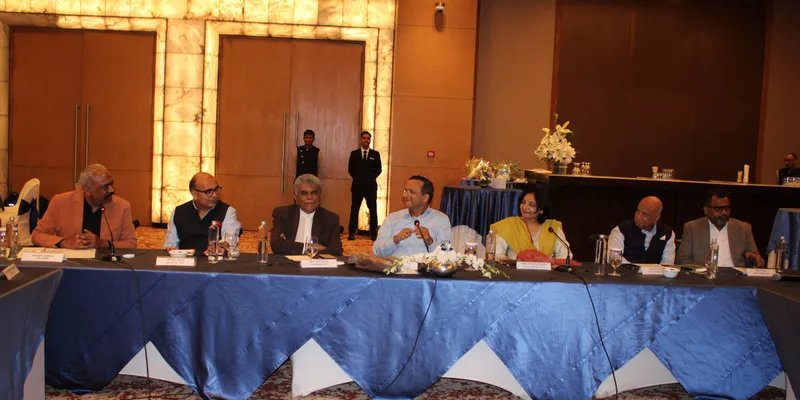
The Apparel Export Promotion Council (AEPC) held a roundtable on evolving global trade dynamics, bringing together government officials, industry stakeholders, buyers, and exporters. The discussion focused on strategies to strengthen India’s apparel exports and align with global market developments.
The event was attended by Chief Guest Mr. Lav Agarwal, IAS, Director General of Foreign Trade (DGFT), Ministry of Commerce, Government of India, and Guest of Honour Ms. Manisha Chatterjee, Joint Secretary, Ministry of Textiles, Government of India.
Chairman AEPC Dr. A. Sakthivel referred to India’s Free Trade Agreements (FTAs) covering nearly 60% of the global population, enabling duty-free access to key apparel markets. He noted that apparel exports have remained at approximately USD 17 billion for nearly a decade and highlighted the need to work towards the target of USD 40 billion by 2030. “The government has shown the way, and buyers are already visiting factories and assessing capacities. Now it is our part to assure the government and the buying fraternity that we will deliver,” Dr. Sakthivel said.
Mr. Lav Agarwal addressed the gathering, referring to the role of FTAs in expanding trade opportunities and outlining priorities including vertical and horizontal expansion, strengthening Brand India in apparel, and improving collaboration among stakeholders. “Every sixth person in the world is Indian. By that numerical strength alone, we should be preparing a strategy that one-sixth of the global trade should be with us in every sector,” he said, adding that government support would continue for exporters.
Ms. Manisha Chatterjee spoke on the need for industry engagement in policy development, particularly in the man-made fibre (MMF) segment. She referred to quality and sustainability requirements in markets such as Europe and Japan and emphasised the importance of meeting these standards. “Europe and Japan are very particular about quality and sustainability. To capture these markets, we must work harder to meet their expectations,” she said. She also mentioned consultations held with Indian ambassadors in Europe to explore export opportunities and invited further industry inputs. “Your inputs are extremely valuable. Together, we can ensure that India’s apparel exports reach new heights,” she added.
Industry participants shared perspectives on capacity expansion, supply chain challenges, and workforce development. Mr. V. Elangovan (Elango), head of SNQS International, Tirupur, highlighted the need to shift from a cotton-dominated fibre mix towards man-made fibres, citing changes in sourcing trends among buyers such as Primark. He also referred to the role of PM MITRA Parks and TUF schemes in supporting capacity expansion.
Other participants discussed the need for skill development initiatives, improved access to financing, and increased participation from small and medium exporters. Buyers highlighted issues related to MMF and polyester supply chains and emphasised the importance of scaling production, upgrading machinery, and ensuring compliance with international standards. Industry representatives also pointed to strengths in fabric capabilities while noting the need for improved marketing and global visibility. Inputs were also shared on workforce development through initiatives such as Samarth 2.0.
Participants indicated the importance of coordination between government, exporters, and buyers to support capacity building, quality improvement, and sustainability in the apparel sector.