A Study on Consumer Buying Behaviour Towards Baby Skincare Products

Ms Shradha Singh, Fashion Management Scholar, Department of Fashion Management
Studies, National Institute of Fashion Technology, Ministry of Textiles, Govt of India, Daman campus.
Abstract
In recent years, the baby skincare product market has witnessed significant growth due to increasing awareness among parents regarding infant health, hygiene, and skin safety. Baby skincare products are considered essential as infants have sensitive and delicate skin that requires special care. Changing lifestyles, rising disposable income, and growing concern for baby wellness have influenced parents’ purchasing decisions. From a consumer behavior perspective, parents exhibit careful and highly involved buying behavior while selecting baby skincare products. Factors such as product safety, brand reputation, ingredient composition, price, doctor recommendations, and social influence play a crucial role in shaping their buying behavior. Additionally, awareness through advertisements, digital media, and word-of-mouth significantly consumer perception and trust. Therefore, understanding consumer buying behaviour towards baby skincare products is essential for manufacturers and marketers to develop effective marketing and product strategies. The present study aims to examine the factors influencing consumer awareness, attitudes, and purchase intentions towards baby skincare products.
Introduction
The baby skincare product industry has gained substantial importance in recent years due to increasing awareness among parents regarding infant health, hygiene, and skin protection. Babies have extremely sensitive and delicate skin, which is more vulnerable to irritation, infections, and environmental factors. As a result, parents are highly cautious while selecting skincare products such as baby soaps, lotions, oils, creams, powders, and shampoos. This growing concern for baby safety and wellness has led to a rapid expansion of the baby skincare market.
Consumer buying behaviour towards baby skincare products is influenced by multiple factors including product safety, quality, brand image, price, availability, and recommendations from pediatrician’s, family members, and peers. With rising literacy levels, urbanization, and exposure to digital media, parents today are more informed and actively seek information about product ingredients, certifications, and suitability before making purchase decisions. Emotional attachment, trust, and perceived risk play a significant role in shaping consumer attitudes toward baby skincare products.
From a marketing perspective, understanding consumer buying behaviour is essential for manufacturers and marketers to design effective product formulations, packaging, pricing, and promotional strategies. Companies focusing on natural, organic, and chemical-free products have gained increased acceptance due to rising concerns about harmful chemicals and allergies. Therefore, studying consumer preferences, attitudes, and purchase intentions towards baby skincare products provides valuable insights for both academic research and practical business applications. The present study aims to analyse the factors influencing consumer buying behaviour and decision-making process towards baby skincare products.
Objectives
1) Understand consumer attitudes/awareness towards baby skincare products. 2) Identify key purchase decision factors
3) Analyses purchase intentions.
Research Methodology
This study follows a theoretical qualitative research approach by reviewing existing literature related to consumer buying behaviour towards baby skincare products. It synthesizes key findings from peer-reviewed journals, scholarly articles, and industry reports to develop a conceptual understanding of factors influencing parental purchase decisions. The data were thematically analyzed to identify recurring patterns, attitudes, concerns, and behavioural drivers such as product safety, brand trust, and perceived risk. The review also highlights research gaps and implications for future studies in consumer behaviour and baby care marketing. The study includes recent publications to ensure relevance to current market trends and consumer awareness. Ethical considerations were followed by selecting credible, peer-reviewed, and open-access sources to maintain academic integrity.
Literature Review
Earlier studies highlight that parents’ purchase decisions for baby skincare products are largely driven by concerns related to infant health, safety, and skin sensitivity. Research indicates that baby skincare is considered a high-involvement product category, as parents perceive a higher level of risk associated with inappropriate product usage. The findings emphasize the growing importance of the baby skincare market, especially in developing economies where awareness regarding infant care is increasing. This literature helps in identifying suitable consumer behaviour models and measurement scales to understand parental attitudes, trust formation, and purchase intentions. Therefore, these studies provide valuable insights for marketers and manufacturers to selectively target parents and caregivers and improve product acceptance.
Singh and Pandey (2019) examined consumer buying behaviour towards baby skincare products in the Indian market and found that safety certifications, ingredient transparency, and pediatricians recommendations play a crucial role in shaping purchase decisions. The study revealed that parents prefer established and trusted brands to minimize perceived risk. Social influence from family members, especially elders, was also found to significantly brand selection. The findings suggest that emotional involvement and protective instincts strongly guide consumer behaviour in baby skincare purchases.
Kumar and Bhatia (2020) reported that increasing education levels and digital awareness have made parents more conscious about reading labels and understanding chemical compositions of baby skincare products. Their study showed that perceived product quality and skin compatibility outweigh price considerations. The research further highlighted that awareness regarding herbal and organic baby skincare products is growing steadily, influencing a shift in consumer preferences. Attitude towards product safety was identified as a mediating factor between awareness and purchase intention.
Sharma and Varma (2021) explored the role of advertising and social influence on baby skincare product purchasing. The study found that word-of-mouth communication, online parenting forums, and social media platforms significantly shape consumer perceptions. Recommendations from paediatricians and healthcare professionals were
identified as the most trusted sources of information. The findings underline the importance of credibility and ethical marketing in influencing parental buying behaviour.
Patel (2022) focused on consumer preference towards organic and natural baby skincare products and observed a rising demand due to concerns about allergies, rashes, and long-term skin health. The study concluded that health consciousness and fear of harmful chemicals strongly influence attitudes and purchase intentions. Parents were willing to pay a premium price for products perceived as safe and chemical-free, indicating a shift toward value-based consumption.
Rao and Mehta (2023) applied the Theory of Planned Behaviour to examine buying intentions toward baby skincare products. The results showed that attitude toward product safety, subjective norms such as family and doctor influence, and perceived behavioural control including product availability significantly active purchase intention. The study confirmed that attitude acts as a key mediator between awareness and actual buying behaviour. These findings provide a theoretical foundation for understanding parental decision-making in baby skincare consumption.
Gupta, R., & Malhotra, S. (2024) examined consumer buying behaviour toward baby skincare products in urban India and found that product safety, dermatological testing, and ingredient transparency significantly influence parental purchase decisions. The study used a survey-based approach and revealed that trust in brand certifications and regulatory approvals plays a crucial role in reducing perceived risk. Social influence from paediatricians and online parenting communities was identified as a strong determinant of purchase intention. The findings suggest that health awareness positively shapes consumer attitudes toward premium baby skincare brands.
Williams, K., & Brown, T. (2025) analyses sustainable and organic baby skincare purchasing behaviour in European markets. Their qualitative study revealed that environmental consciousness and ethical concerns increasingly influence parents’ brand choices. Parents expressed higher trust in brands o¯ering transparency, cruelty-free testing, and eco-friendly packaging. The study suggests that sustainability has become an important dimension in shaping consumer attitudes toward baby skincare products.
Insights from Literature Review
The literature highlights the Theory of Planned Behaviour (TPB) and Theory of Reasoned Action (TRA) as ejective frameworks for understanding consumer buying behaviour towards baby skincare products. Studies published in the Journal of Retail and Consumer Studies and the
Asian Journal of Business Research shows that attitude toward product safety, ingredient quality, and skin compatibility is a stronger predictor of purchase intention than price or convenience (Singh & Pandey, 2019; Rao & Mehta, 2023).
Research in the International Journal of Marketing Studies and Journal of Consumer Studies indicates that buying behaviour varies across markets, with Indian consumers relying on pediatricians and family influence, while consumers in developed markets prioritize dermatological testing and organic certifications (Kumar & Bhatia, 2020; Lee & Park, 2024). Overall, the literature confirms that attitude toward safety mediates social influence and purchase intention in the baby skincare market.
Findings
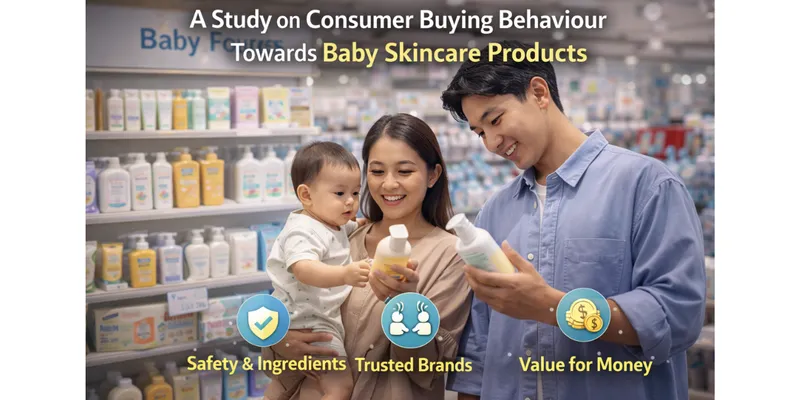
The findings indicate that consumer buying behaviour towards baby skincare products is influenced by a combination of health-related, emotional, and product-specific factors. Parents place the highest importance on product safety, ingredient quality, and skin compatibility when selecting baby skincare products. Brand trust and certifications play a vital role in reducing perceived risk and enhancing purchase confidence. Recommendations from pediatrician’s, family members, and healthcare professionals significantly influence parental purchase decisions. Digital media, advertisements, and online parenting communities have increased awareness and informed decision-making among parents. There is also a growing preference for organic,
natural, and sustainable baby skincare products, driven by concerns about allergies, long-term skin health, and environmental responsibility. Despite rapid market growth, research gaps remain in specific regional contexts, indicating opportunities for further academic studies and targeted marketing strategies.
Parents’ buying behaviour towards baby skincare products is influenced by a combination of psychological, social, and product-related factors, which can be clearly understood through the Theory of Planned Behaviour (TPB) and Theory of Reasoned Action (TRA). Attitude toward product safety and skin compatibility plays a dominant role—for example, parents prefer brands like Johnson’s Baby or Seamed because they are dermatologically tested and claim to be gentle on sensitive baby skin. Subjective norms, such as recommendations from paediatricians and family elders, strongly decisions; for instance, many parents purchase Himalaya Baby Care products after a doctor’s suggestion or family advice. Perceived risk and parental responsibility further encourage careful evaluation of ingredients, leading parents to avoid products containing parabens or artificial fragrances. Additionally, media and digital influence, such as reviews on parenting blogs and social media, shape trust and awareness—new parents often choose organic brands like mama earth after reading online testimonials. These examples show that emotional concern for infant safety, combined with social influence
and trust in certified products, strongly drives consumer buying behaviour in the baby skincare market.
Conclusion
In conclusion, consumer buying behaviour towards baby skincare products is shaped by a combination of emotional attachment, perceived risk, social influence, and product-related attributes. Behavioural theories such as the Theory of Planned Behaviour and Theory of Reasoned Action selectively explain how parental attitudes and subjective norms influence purchase intention. Attitude toward product safety emerges as the most significant determinant of buying behaviour. Social influence from doctors and family members continues to guide parental decisions, while cultural and regional deference’s action product preferences and trust levels. Increased media exposure and digital platforms play a crucial role in spreading awareness and influencing consumer choices. Modern parents prefer safe, effective, avoidable, and user-friendly baby skincare products. However, limited region-specific research
highlights the need for further studies to support evidence-based marketing strategies and product development in the baby skincare industry.
References
1. Singh, R., & Pandey, S. (2019). Consumer buying behaviour towards baby care products in India. International Journal of Marketing and Consumer Research, 8(2), 45–52.
2. Kumar, A., & Bhatia, S. (2020). Awareness and perception of parents towards baby skincare products. Journal of Consumer Behaviour Studies, 5(1), 33–41. 3. Sharma, P., & Varma, R. (2021). Impact of advertising and social influence on baby skincare product purchasing. International Journal of Business and Management Research, 9(3), 112–120.
4. Patel, M. (2022). Consumer preference towards organic baby skincare products. Asian Journal of Marketing and Management, 11(4), 67–75.
5. Rao, S., & Mehta, N. (2023). Application of the Theory of Planned Behaviour in baby skincare purchase intention. Journal of Retailing and Consumer Behaviour, 14(2), 89–98.
6. Gupta, R., & Malhotra, S. (2024). Consumer buying behaviour towards baby skincare products in urban India. International Journal of Consumer Studies, 48(1), 56–65.