A Study of Impulse Buying Behavior Among Women Consumers in the Fashion Industry

Ms Somya Kothari, Fashion Management Scholar, Department of Fashion Management Studies, National Institute of Fashion Technology (NIFT), Ministry of Textiles, Govt of India.
Abstract
Impulse buying has emerged as a prominent feature of the fashion industry, driven by rapidly changing trends, emotional appeal, and highly competitive marketing practices. Women consumers represent one of the most influential segments in fashion consumption and are particularly susceptible to spontaneous purchasing decisions shaped by psychological, social, and situational factors. Fashion products such as apparel, footwear, and accessories are expressive in nature and closely associated with emotions, self-image, and social identity, making them especially prone to impulse buying.
The expansion of e-commerce, social media platforms, influencer marketing, discount-driven promotions, and visually stimulating retail environments has further intensified impulse buying behaviour among women. From a consumer behaviour perspective, such purchases are influenced by internal factors including mood, emotions, stress, and self-gratification, as well as external stimuli such as store atmosphere, promotional offers, peer influence, and digital exposure. This study aims to develop a conceptual understanding of impulse buying behaviour among women consumers in the fashion industry by analysing psychological, emotional, and marketing-related drivers of unplanned fashion purchases.
Introduction
The fashion industry is widely recognized as one of the most dynamic and competitive sectors, characterized by fast-changing trends, seasonal collections, and high levels of consumer involvement. In such a fast-paced environment, impulse buying plays a vital role in driving sales and shaping overall consumer behaviour. Impulse buying refers to spontaneous and unplanned purchases that occur without deliberate intention and are often triggered by emotional or situational cues.
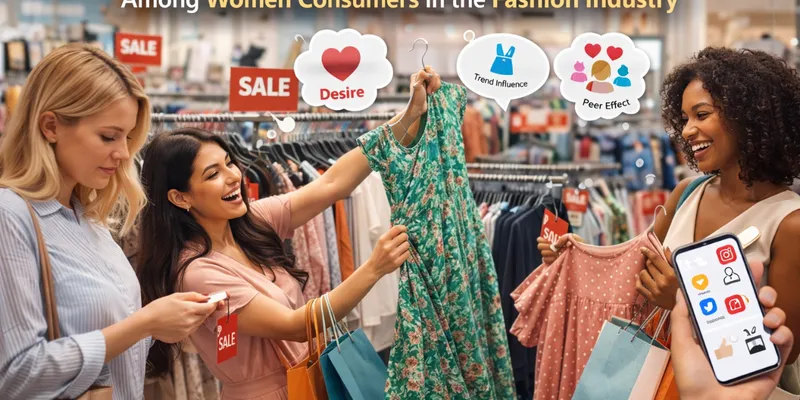
Women consumers play a central role in fashion consumption, not only as primary buyers for themselves but also as key influencers in household and social purchasing decisions. Fashion products are closely linked to women’s self-expression, confidence, and emotional well-being. Elements such as attractive visual merchandising, limited-time discounts, influencer endorsements, and continuous social media exposure frequently stimulate impulse buying behaviour.
With the growth of online shopping platforms and social commerce, impulse buying behaviour has evolved further. Features such as flash sales, personalized recommendations, seamless payment options, and constant exposure to fashion-related content encourage spontaneous purchasing decisions. From a fashion management perspective, understanding impulse buying behaviour among women is essential for developing consumer-centric and ethically responsible marketing strategies.
Objectives
• To review existing literature related to impulse buying behaviour among women consumers in the fashion industry.
• To theoretically analyse psychological and emotional factors influencing impulse buying in fashion consumption.
• To suggest managerial implications and action plans for fashion marketers based on insights from the literature.
Research Methodology
This study adopts a qualitative and theoretical research approach based on an extensive review of existing academic literature. Peer-reviewed journals, research articles, and scholarly publications in the domains of consumer behaviour, fashion marketing, and retail management were systematically analysed.
The reviewed studies were thematically examined to identify recurring patterns and key determinants of impulse buying behaviour among women consumers. Particular attention was given to psychological, emotional, social, and marketing-related variables. Ethical standards were maintained by relying exclusively on credible and published academic sources. This conceptual approach enables a comprehensive understanding of impulse buying behaviour within the fashion industry.
Literature Review
Rook (1987) was among the first scholars to conceptualize impulse buying as a sudden and compelling urge to purchase, accompanied by emotional excitement and limited cognitive evaluation. This perspective highlights the hedonic nature of impulse buying, which is especially relevant in the fashion context where products are symbolic and emotionally driven.
Beatty and Ferrell (1998) proposed a comprehensive model incorporating individual traits, situational factors, and retail stimuli as predictors of impulse buying behaviour. Their findings suggest that women who view shopping as an enjoyable or recreational activity are more likely to engage in impulsive fashion purchases.
Verplanken and Herabadi (2001) further expanded the concept by distinguishing between cognitive and affective dimensions of impulse buying. Their work indicates that women display stronger affective responses, making them more emotionally receptive to fashion-related stimuli such as discounts and visual merchandising.
Park, Kim, and Forney (2006) focused specifically on fashion-oriented impulse buying and demonstrated that high fashion involvement, hedonic consumption, and positive emotions significantly increase impulsive purchasing tendencies among women. Similarly, Dholakia (2000) emphasized the role of desire, self-control, and environmental cues in shaping impulse buying decisions.
Recent studies also emphasize the growing influence of e-commerce and social media. Features such as scarcity messages, influencer endorsements, and fear of missing out (FOMO) strongly encourage spontaneous fashion purchases. Post-purchase emotions such as satisfaction, guilt, and regret further influence long-term consumer behaviour and brand relationships.
Findings
The reviewed literature indicates that impulse buying behaviour among women consumers in the fashion industry is primarily driven by emotional and situational factors rather than rational evaluation. Promotional offers, discounts, attractive visual displays, and social media exposure significantly increase the likelihood of impulsive purchases. While impulse buying often results in immediate pleasure and satisfaction, it may also lead to post-purchase guilt or regret, reflecting the emotional complexity of fashion consumption.
Conclusion
Impulse buying behaviour among women consumers represents a significant and influential dimension of the fashion industry. Emotional needs, social influence, and marketing stimuli such as discounts, visual merchandising, and digital exposure strongly shape spontaneous purchasing decisions. The expanding role of online platforms and social media has further intensified impulsive fashion consumption. A clear understanding of these behavioural patterns can help fashion brands and retailers design effective, ethical, and sustainable marketing strategies. Future research may focus on empirical validation, generational comparisons, and the relationship between impulse buying and sustainable fashion consumption.
References
Beatty, S. E., & Ferrell, M. E. (1998). Impulse buying: Modeling its precursors. Journal of Retailing, 74(2), 169–191.
https://scholar.google.com/scholar?q=Impulse+buying+Modeling+its+precursors+Beatty+Ferrell
Rook, D. W. (1987). The buying impulse. Journal of Consumer Research, 14(2), 189–199.
https://scholar.google.com/scholar?q=The+buying+impulse+Rook
Verplanken, B., & Herabadi, A. (2001). Individual differences in impulse buying tendency. Journal of Economic Psychology, 22(1), 71–95.
https://scholar.google.com/scholar?q=Individual+differences+in+impulse+buying+tendency
Park, E. J., Kim, E. Y., & Forney, J. C. (2006). A structural model of fashion-oriented impulse buying behavior. Journal of Fashion Marketing and Management, 10(4), 433–446.
https://scholar.google.com/scholar?q=fashion+oriented+impulse+buying+Park+Kim+Forney
Dholakia, U. M. (2000). Temptation and resistance: An integrated model of consumption impulse formation and enactment. Psychology & Marketing, 17(11), 955–982.
https://scholar.google.com/scholar?q=Temptation+and+resistance+Dholakia
Sharma, P., Sivakumaran, B., & Marshall, R. (2010). Impulse buying and variety seeking. Journal of Business Research, 63(3), 276–283.
https://scholar.google.com/scholar?q=Impulse+buying+and+variety+seeking+Sharma