3D Weaving Market to Hit USD 105.97M by 2034, CAGR 12.5%
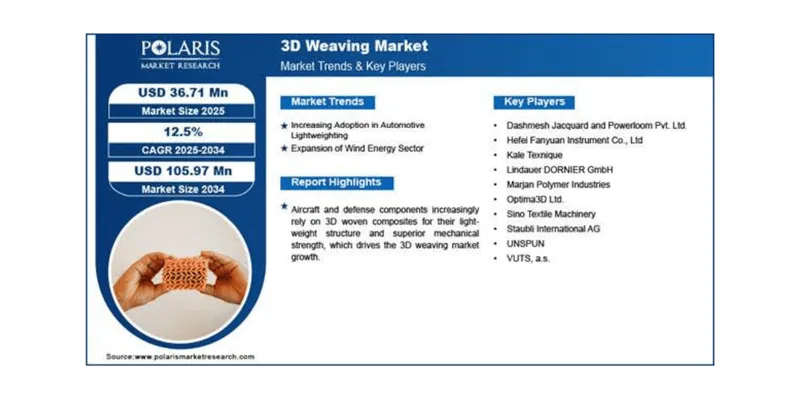
The 3D weaving market is experiencing strong growth as industries increasingly adopt advanced textile technologies for high-performance applications. By interlacing fibers in three dimensions, 3D weaving creates fabrics with superior mechanical strength and reduced weight, making them ideal for use in aerospace, automotive, and construction sectors.
Understanding 3D Weaving
3D weaving is an advanced textile process that allows the creation of fabrics with a three-dimensional structure. Unlike conventional weaving that interlaces yarns in two directions, 3D weaving adds yarns in the thickness direction, resulting in stronger, more durable fabrics suitable for demanding applications.
Types of 3D Weaving Machines
- Glass Fiber Weaving Machines: Designed for strong, chemically stable fabrics used in aerospace, marine, and construction composites.
- Composite Textile Weaving Machines: Combine multiple fibers such as carbon, aramid, and glass to produce multi-layered, performance-optimized fabrics.
- Spacer Weaving Machines: Produce fabrics with a middle spacer layer, offering cushioning, insulation, and impact resistance, making them suitable for medical textiles, upholstery, and protective clothing.
- Carbon Weaving Machines: Specialize in weaving carbon fibers to create lightweight, fatigue-resistant 3D structures widely used in aerospace, automotive, and sports equipment sectors.
Market Outlook and Growth
According to Polaris Market Research, the 3D weaving market is projected to reach USD 105.97 million by 2034, registering a 12.5% CAGR from 2025 to 2034.
Key Market Drivers
- Lightweight & Durable Materials: Growing demand from aerospace and automotive industries for components that combine strength with reduced weight is fueling adoption.
- Technological Advancements: Innovations in machinery, automation, and CAD are improving production efficiency, enabling customized, high-quality 3D woven fabrics.
Market Trends
- Integration with Advanced Fibers: Manufacturers are increasingly using carbon, glass, and aramid fibers to create high-performance composites with enhanced thermal resistance and impact absorption.
- Sustainability: 3D weaving minimizes material waste and supports the use of bio-based fibers, aligning with global efforts to adopt eco-friendly solutions.
The future of the 3D weaving market looks promising, with continuous innovation, sustainability initiatives, and expanding applications driving growth and adoption across industries.