3D Printing Materials Market Projected to Reach $10.02 Billion by 2030
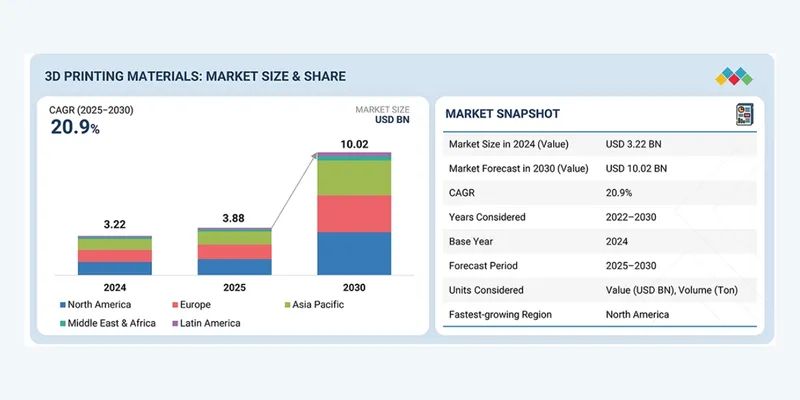
The global 3D Printing Materials Market is projected to grow from USD 3.88 billion in 2025 to USD 10.02 billion by 2030, according to a new market report. The market is expected to expand at a compound annual growth rate (CAGR) of 20.9% between 2025 and 2030, driven by research and development activities and collaborations among industry participants.
The market is expected to register a CAGR of 20.9% during the forecast period from 2025 to 2030.
According to the report, research and development investments and strategic collaborations among major industry participants are contributing to market expansion. Partnerships between companies are facilitating developments in materials, improvements in printing technologies, and the creation of application-specific solutions.
These collaborations are also supporting improvements in the scalability and quality of 3D printing processes. The development of advanced materials and technologies is enabling broader use of 3D-printed components in sectors including aerospace, biomedical, and electronics.
The report identifies several companies operating in the market, including 3D Systems, Inc. (US), Stratasys (US), Arkema (France), Evonik Industries AG (Germany), GE Aerospace (US), and Sintokogio, Ltd. (Japan).
The study outlines several objectives, including defining and forecasting the market size in terms of volume and value. It also analyzes factors affecting market growth, such as drivers, restraints, opportunities, and challenges.
The report evaluates the market based on type, form, technology, application, end-use industry, and region.
It also provides market projections across five major regions, including North America, Europe, Asia Pacific, the Middle East & Africa, and Latin America, along with country-level analysis.
The study further examines growth trends in individual micromarkets, their contribution to the overall market, and the opportunities available to stakeholders.
Additionally, the report reviews recent developments in the industry, including agreements, contracts, acquisitions, product developments, and product launches, to analyze the competitive landscape.
The analysis also includes strategic profiling of key market participants and an assessment of their core competencies.