TO ANALYSE THE FINANCIAL PERFORMANCE OF RAJA BAHADUR INTERNATIONAL LIMITED
1. Introduction
- Introduction of the company
A fresh start comes from Mumbai, where Raja Bahadur International Limited calls home. This publicly traded name dives into shaping buildings, crafting spaces, while also renting out office spots. Work unfolds across plots held outright, alongside active builds taking shape. Much of that energy flows toward Pune, though Mumbai stays central too.
- Industry Overview
The Indian real estate sector has been witnessing consolidation and formalization due to regulatory frameworks like RERA and increased institutional funding. Commercial real estate, especially office and mixed-use developments, is driven by leasing demand and rental yields. However, the sector remains capital-intensive and highly sensitive to interest rates and liquidity cycles.
- Purpose of the Analysis
The main purpose of this study is to analyse the business operations and structure of Raja Bahadur International Ltd. and to understand the financial performance of the company.
2. Company Overview
- Background and History
- Raja Bahadur International Limited (RBIL), formerly known as The Raja Bahadur Motilal Poona Mills Ltd., was promoted by the Pittie family, renowned entrepreneurs, around the end of 19th century of before independent India and was started as a Public Limited Company in 1926 for carrying out the manufacture of textile products.
- The Company also diversified further and was the first in terms of production of drawing office / reprographic equipment, mini drafters and high precision machine tool accessories. The Company sells its products under the brand name of PITTIE that was adopted by the masses (both the public and the PR) as a symbol of quality throughout the nation.
- RBIL, in the short span of its Real Estate development activities, has earned a reputation for quality construction of high-end office space.
- Business Model
Revenue streams:
- Sales of developed real estate units
- Lease rentals from commercial properties
- Project-based income recognition
Uses project financing (bank + NBFC loans) backed by:
- Mortgage of land/buildings
- Custody of receivables
It has heavy dependence on debt-funded development and rental cash flows
- Key Products / Services
The company’s product portfolio is based mainly on the following:
- Commercial office spaces (e.g., Commercial Tower projects)
- Real estate development projects
- Lease/licensing of constructed properties
- Market Position
The company operates as a mid-sized niche real estate developer with a market cap. of 108 Cr with strong asset backing rather than large-scale volume-driven operations. Its positioning is asset-heavy with rental income support, but limited diversification compared to major listed real estate players.
3. Promoter /Founder Introduction
Name | Professional Background | Role in Company |
Shridhar Pittie | MBA (Finance), extensive experience in business & real estate | Chairman & Managing Director; key decision-maker, financing & project execution leadership |
Umang Pittie | MSc (Marketing & Strategy), 15+ years in real estate | Handles day-to-day operations and project execution |
Vaibhav Pittie | IIT Bombay (Civil Engineer.), ex-BCG | Focus on strategy, finance, and legal structuring |
4. Financial Statement Analysis
- Income Statement Analysis
Metric | FY2023 | FY2024 | FY2025 |
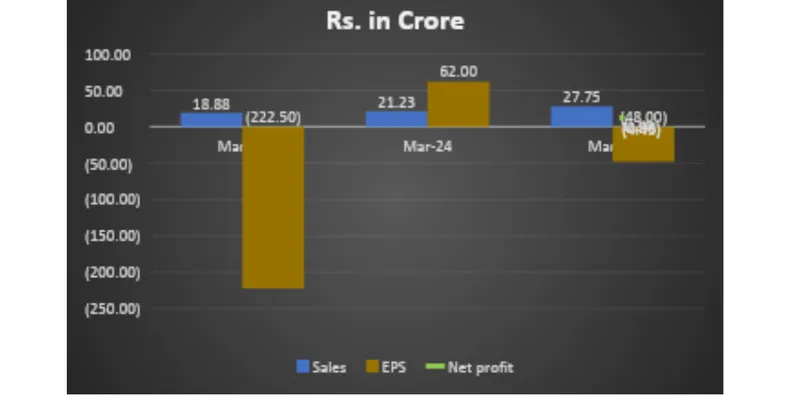
Net Sales Revenue | ₹18.88 Cr | ₹21.23 Cr | ₹140.81 Cr |
Net Profit After Tax | ₹-4.45 Cr | ₹1.24 Cr | ₹-0.96 Cr |
Key Observations of Income Statement:
- In FY 2025, Revenue increased substantially from the previous year.
- Net Profit turned negative due to deferred tax and huge interest amount in FY 2025.
- Balance Sheet Analysis (Rs. In crore)
Narration | Mar-23 | Mar-24 | Mar-25 |
Equity Share Capital | 2.50 | 2.50 | 2.50 |
Total Liabilities (Borrowings+Current) | 147.20 | 170.24 | 229.94 |
Total Assets (Fixed+Current) | 103.66 | 141.72 | 150.39 |
As of FY25:
- Total liabilities increased sharply in FY 2025 and Equity Share Capital remained the same.
- Total Assets increased significantly from the previous year.
- Cash Flow Statement Analysis (Rs. In crore)
FY25 highlights:
- Operating cash flow has increased substantially from last year.
- Investing cash flow has declined significantly from previous year.
- Financing cash flow has increased significantly from last year.
- Key Financial Ratios (Indicative)
Category | Ratio | Value | Interpretation |
Profitability | Net Profit Ratio | -3% | Indicates loss in FY25 due to high finance cost and deferred tax |
Liquidity | Current Ratio | 1.60 | Shows adequate ability to meet short-term obligations |
Leverage | Debt-Equity Ratio | 18.72 | Extremely high leverage |
Efficiency | Asset Turnover Ratio | 0.05 | Very low efficiency in utilizing assets |
- Year-on-Year Comparison (3 years)
Revenue Chart
5. Key Insights & Interpretation
- Strengths
- Strong asset base (land + commercial properties)
- Stable rental income streams (lease agreements)
- Increasing revenue trend driven by project monetization
- Weaknesses
- Extremely high debt levels (debt-equity ~18x)
- Profitability is highly volatile due to finance costs (~₹16.6 Cr)
- Heavy reliance on few key projects (Pune concentration)
- Negative retained earnings trend
- Risk Factors
- Interest rate risk due to high borrowing exposure
- Liquidity risk if project cash flows slow down
- Real estate cycle dependency (demand fluctuations)
- Project-specific risks (delays, unsold inventory)
- Future Outlook
The company’s outlook depends largely on successful monetization of its Pune commercial projects and reduction in financing costs. Management is focusing on refinancing high-cost debt into lower-cost borrowing, which could improve profitability. However, sustained growth will require better cash flow management and gradual deleveraging.
6. Conclusion
Final Evaluation of Financial Health
A closer look at Raja Bahadur International Limited reveals rising income and solid holdings. Yet debt levels sit high, profits waver. Strength on one side, strain on another. Stability feels uncertain when numbers jump without patterns. Growth exists - burden shadows it.
Investment / Performance Perspective
From an investment standpoint, the company suits high-risk investors who believe in real estate asset appreciation and turnaround potential. Conservative investors may avoid due to:
- High debt burden
- Volatile earnings
- Dependence on project execution
- Data Sources
https://www.screener.in/company/503127/