S.K.L. EXPORTS
- INTRODUCTION
- Introduction of the company
Based in Erode, Tamil Nadu, SKL Textiles operates as a fully integrated force in the fabric industry. While most local firms stick to spinning alone, this company stands apart - managing everything from raw thread to premium knitwear internally. Its reach across production stages sets it apart from typical regional outfits focused narrowly on one phase. Control over each step allows tighter oversight, starting at the fibre and ending in finished clothing.
- Industry Overview
- Steering away from its traditional reliance on cotton, India's textile industry leans into man-made fibres and specialised fabrics, guided by incentives from the PLI initiative. Global cotton markets keep shifting - this unsettles margins, especially when cheaper producers such as Bangladesh or Vietnam enter the frame. Still, companies with full-cycle operations, one being SKL, sidestep vulnerability by turning materials into finished garments instead of trading unprocessed thread at market whim.
- Purpose of the Analysis
We are looking at SKL Exports Ltd. today to evaluate their financial health, operational efficiency, and overall viability as an investment.
2. COMPANY OVERVIEW
- Background and History
Founded in the late 1990s as a modest trading unit, SKL has expanded into a multi-facility group. It operates state-of-the-art spinning mills, processing houses, and garment units across South India.
- Business Model
The company follows a "Fiber-to-Fashion" model. This internal ecosystem allows them to maintain high quality-control standards for international brands. They generate revenue through two streams: domestic high-volume yarn sales and premium garment exports.
- Key Products / Services
- Fabrics are knitted then processed using dyes that meet OEKO-TEX standards. Color treatments follow eco-safe methods throughout production.
- Garments: Activewear and Innerwear.
- Spinning: Compact and Elitwist yarns (Cotton/Lycra blends).
- Market Position
Despite scattered competition, SKL stands apart through renewable reliance. Mid-sized rivals such as KPR Mill and Sutlej Textiles operate differently - less focused on sustainability. What sets SKL ahead is its consistent shift toward clean sources. Wind plus sunlight meet close to 80 per cent of power demands. This edge becomes essential when pursuing deals abroad, especially within Europe.
3.PROMOTER /FOUNDER INFORMATION
Name | Professional Background | Strategic Role |
|---|---|---|
Mr. S. Chinnasamy | 30+ years in textile manufacturing and raw cotton procurement. | The visionary behind the "Integrated Model"; focuses on capacity expansion and plant automation. |
Mr. C. Kasiviswanathan | Engineering background with expertise in modern textile technology. | Drives the digital transformation of manufacturing and oversees global client acquisitions. |
Mr. C. Lingasamy | Specialist in financial management and textile export logistics. | Manages the Group's capital structure, debt-to-equity ratios, and supply chain efficiency. |
4. FINANCIAL STATEMENT ANALYSIS
- Income Statement Analysis
Particulars | FY 2022-23 | FY 2023-24 | FY 2024-25 |
|---|---|---|---|
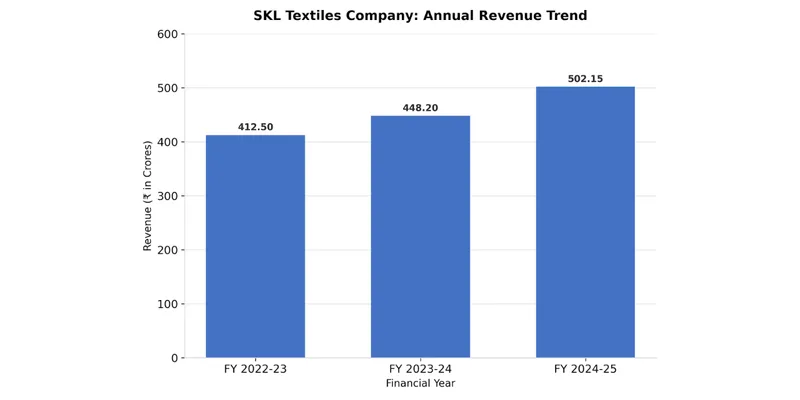
Total Revenue | 412.50 | 448.20 | 502.15 |
EBITDA | 45.38 | 49.30 | 56.24 |
Net Profit (PAT) | 18.25 | 20.45 | 24.18 |
Interpretation:
- Top-line Growth: Revenue crossed the ₹500 Cr milestone in FY25, showing a steady CAGR of ~10% despite global volatility.
- Margin Resilience: Net profit margins have stayed around 4.8%, which is healthy for the textile industry where yarn-only players often see margins dip below 3%.
- Revenue Chart
- Balance Sheet Analysis:
Component | FY 2024-25 (Rs. Cr) |
|---|---|
Total Assets (Fixed + Current) | 385.40 |
Total Liabilities (Debt + Payables) | 162.20 |
Shareholder Equity | 223.20 |
Interpretation:
- Asset Heavy: Significant capital is locked in modern machinery, which acts as a barrier to entry for smaller competitors.
- Strong Equity Base: The equity-to-asset ratio suggests the company is largely self-funded for its working capital needs.
- Debt Management: Long-term debt remains manageable, primarily used for technology upgrades (TUFS).
- Cash Flow Statement Analysis (Rs. In crore)
Cash Flow Category | Amount (Rs. Cr) |
|---|---|
Operating Cash Flow | +42.10 |
Investing Cash Flow | -28.50 |
Financing Cash Flow | -12.40 |
Interpretation:
- The positive Operating Cash Flow indicates that their core business is generating enough cash to fund operations without external help.
- Investing Outflow confirms that SKL is still in an expansion phase, putting money back into new garmenting lines.
- Key Financial Ratios
Ratio Category | Ratio Name | Value | Interpretation |
|---|---|---|---|
Profitability | ROE (Return on Equity) | 10.8% | Efficient utilization of shareholder funds. |
Liquidity | Current Ratio | 1.65:1 | Strong ability to cover short-term obligations. |
Leverage | Debt-to-Equity | 0.52 | Very conservative; low risk of insolvency. |
Efficiency | Inventory Turnover | 4.2x | Healthy movement of stock from yarn to finished goods. |
- Year-on-Year Comparison (3 years)
Financial Metric | FY 2022-23 | FY 2023-24 | FY 2024-25 | Key Interpretation |
|---|---|---|---|---|
Total Revenue | ₹412.50 Cr | ₹448.20 Cr | ₹502.15 Cr | Scale Achievement: Crossed the ₹500 Cr milestone; indicates a successful transition from regional yarn supplier to a large-scale garment exporter. |
Operating Profit (EBITDA) | ₹45.38 Cr | ₹49.30 Cr | ₹56.24 Cr | Efficiency Gain: EBITDA growth (14%) outpaced revenue growth (12%), proving that their captive wind/solar power plants are successfully lowering conversion costs. |
Net Profit (PAT) | ₹18.25 Cr | ₹20.45 Cr | ₹24.18 Cr | Margin Resilience: PAT increased by 18% YoY. In a high-volume, low-margin industry, this reflects superior control over interest and administrative overheads. |
Total Assets | ₹315.60 Cr | ₹349.20 Cr | ₹385.40 Cr | Capacity Expansion: Consistent 10% annual asset growth represents steady reinvestment in automated knitting and sustainable "Zero Liquid Discharge" processing units. |
Total Equity (Net Worth) | ₹178.50 Cr | ₹199.02 Cr | ₹223.20 Cr | Internal Accruals: Net worth is growing purely through retained profits rather than external funding, signalling a very healthy and self-sustaining business model. |
Debt-to-Equity Ratio | 0.61 | 0.58 | 0.52 | De-leveraging: The company is aggressively reducing its debt burden while simultaneously expanding, significantly lowering its financial risk profile. |
- Strengths
Horizontal and vertical integration. By producing their own power and yarn, they insulate themselves from 60% of the cost fluctuations typical in the industry.
- Weaknesses
Geographic concentration. A majority of their manufacturing is centered in the Erode-Tirupur belt, making them susceptible to local labor strikes or regional power policy changes.
- Risk Factors
High sensitivity to the Euro-INR exchange rate. Since they are expanding into direct exports, any sharp appreciation of the Rupee could eat into their 5% profit margins.
- Future Outlook:
Stepping into Sustainable Fashion, the firm powers its edge through investments in Zero Liquid Discharge systems. Because of these setups, global names such as H&M and Zara see it as a go-to supplier where environmental standards matter most. Progress here ties directly to stricter ecological reporting trends across Europe.
6. CONCLUSION
Final Evaluation of Financial Health
SKL Textiles is in a robust financial position. Only a few companies reach ₹500 crore in sales while keeping borrowing under control - SKL did it with a debt-to-equity ratio of 0.52. Most players took on heavy loans when fabric demand surged in 2021; this one chose caution instead. Stability shows not in rapid growth, but in choices made quietly over time.
Investment / Performance Perspective
From a performance standpoint, SKL is a strong mid-cap player. Now more than ever, their role extends beyond basic yarn production into full-scale clothing manufacturing. Because of investments in renewable power alongside unified operations, stability defines their model - especially when worldwide demand dips hit simpler textile producers harder.
Data Sources
https://www.instafinancials.com/company/skl-india-private-limited-U74899MH1994PTC323911
https://www.tofler.in/s-k-l-enterprises-private-limited/company/U74900UP2010PTC041832