MANUFACTURER PERFORMANCE SCORE (MPS): A CIBIL-INSPIRED FRAMEWORK FOR EVALUATING MANUFACTURING RELIABILITY IN GLOBAL TRADE
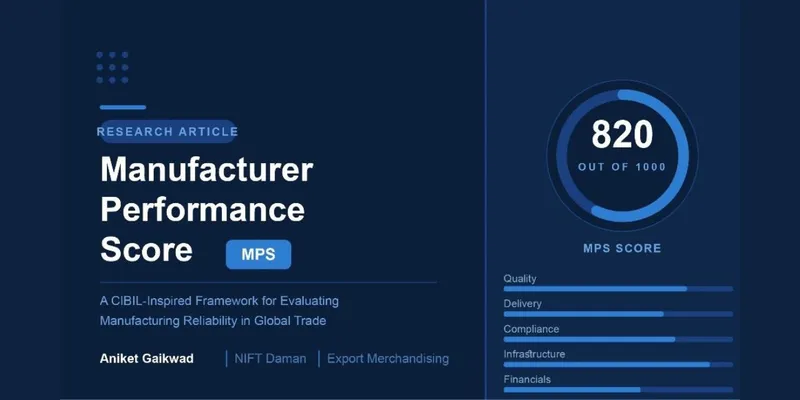
By Aniket Gaikwad
Scholar, Export Merchandising
National Institute of Fashion Technology (NIFT), Daman
Email: aniket.bhausahebgaikwad@nift.ac.in | Date: 31 March 2026
Abstract
Finding a good manufacturer in global trade is slow, expensive, and risky. Buyers must visit factories, hire costly auditors, and still cannot be fully sure of the result. Small buying houses especially struggle because they cannot afford these audits. This article proposes a simple solution, a Manufacturer Performance Score (MPS). Just like a CIBIL score tells a bank how trustworthy a borrower is, the MPS tells a buyer how reliable a factory is. One number, between 0 and 1000, that covers everything including product quality, on-time delivery, factory condition, worker safety, financial health, and past buyer feedback. The score would be maintained by a neutral body, updated regularly using real trade data, and accessible to any buyer at any time, making sourcing faster, cheaper, and more transparent for everyone.
Keywords: Manufacturer Performance Score, Factory Rating, Supply Chain, Export Merchandising, Sourcing, Global Trade
Research Area: Supply Chain Transparency and Manufacturer Evaluation in Global Trade
I. INTRODUCTION
When a company in Europe or America wants to buy 10,000 T-shirts or 5,000 shoes from a factory in India, a fundamental question arises: how do they know if that factory is reliable? How do they verify timely delivery, fair treatment of workers, or the condition of the machinery? At present, these questions have no simple answers.
The global trade industry relies heavily on physical factory visits, third-party audits, and personal references, methods that are slow, expensive, and largely inaccessible to smaller buyers. A mid-sized buying house or a new-to-export entrepreneur is left navigating the manufacturer landscape almost blindly.
This paper proposes a solution modelled after a system that already works extremely well in India's financial sector: the CIBIL credit score. Just as CIBIL gives banks a single, reliable number to assess a borrower's creditworthiness, a Manufacturer Performance Score (MPS) would give buyers a single, reliable number to assess a factory's trustworthiness. This paper outlines the concept, its scoring framework, its benefits, existing gaps it fills, and the challenges involved in its implementation.
II. STATEMENT OF THE PROBLEM
Consider a buying house in Mumbai receiving an order from an Italian brand for 20,000 jackets. The standard process for factory evaluation involves the following steps:
- Visiting five to six factories in person, requiring travel, time, and significant cost.
- Inspecting machinery, workforce, and storage facilities manually.
- Commissioning sample orders and waiting several weeks for results.
- Hiring a third-party audit firm, which alone can cost between Rs. 50,000 and Rs. 1,50,000 per factory.
This entire process can take two to three months. Despite this investment of time and resources, supply chain failures, late deliveries, and quality defects remain common. The root cause is the absence of a standardised, accessible, and continuously updated evaluation system for manufacturers.
III. THE CONCEPT: MANUFACTURER PERFORMANCE SCORE (MPS)
The Manufacturer Performance Score (MPS) is proposed as a standardised rating system for factories and manufacturing units. Modelled after the CIBIL credit scoring system used in India's banking sector, the MPS would generate a score between 0 and 1000 for each registered manufacturer, based on verified, multi-dimensional performance data.
The analogy is straightforward. A person with a CIBIL score above 800 is considered creditworthy and receives loans with ease. Similarly, a factory with an MPS above 800 would be considered a reliable manufacturing partner and attract buyer confidence. A low score, in either case, signals risk.
Unlike a one-time audit report, the MPS would be a living score, continuously updated as new data becomes available, much like how a credit score updates with each financial transaction.
IV. SCORING FRAMEWORK
The MPS would be calculated across six core dimensions, each assigned a weighted contribution to the total score of 1000 points:
4.1 Product Quality (25%)
This dimension evaluates defect and rejection rates from past orders, quality certifications held such as ISO 9001, OEKO-TEX, and GOTS, as well as results from third-party quality inspections. Factories with consistently low defect rates and recognised certifications score highest in this category.
4.2 Delivery Reliability (20%)
This dimension measures a factory's on-time delivery rate, the accuracy of committed lead times, and the order fulfilment percentage. Factories that consistently meet their delivery commitments are rewarded with higher scores, while chronic delays reduce the rating.
4.3 Infrastructure and Capacity (15%)
The age and operational condition of machinery installed production capacity relative to actual utilisation, and the stability and skill level of the workforce are evaluated in this dimension. A factory with modern equipment and a trained, consistent workforce represents lower operational risk.
4.4 Labour and Environmental Compliance (20%)
This dimension assesses adherence to labour laws, working conditions, environmental certifications, fire safety compliance, and structural safety standards. With international buyers increasingly prioritising ethical sourcing, this dimension carries significant weight in the overall score.
4.5 Financial Stability (10%)
Payment history to raw material suppliers, business continuity over time, and the absence of significant legal or financial disputes are evaluated here. A financially unstable factory presents a supply chain risk, as it may be unable to complete orders or sustain operations.
4.6 Buyer Feedback and Reputation (10%)
Verified ratings from previous buyers, repeat order rates, and dispute resolution history form the basis of this dimension. Buyer feedback is considered one of the most direct and honest indicators of a manufacturer's real-world performance.
V. GAP ANALYSIS: WHY EXISTING SYSTEMS ARE INSUFFICIENT
Several tools currently exist for factory evaluation. However, none of them fulfil the role proposed for the MPS. A brief comparison is presented below:
Existing System | What It Does | Key Limitation |
|---|---|---|
Alibaba Gold Supplier | Verifies factory registration on platform | Paid membership, not a performance measure |
SGS / Bureau Veritas Audit | Detailed one-time factory inspection | Costs Rs. 40,000 to Rs. 1,60,000; not continuously updated |
SMETA Ethical Audit | Evaluates labour and ethical standards only | Does not cover quality, delivery, or financial health |
Alibaba / IndiaMART Ratings | Buyer reviews on sourcing platforms | Not standardised; easily manipulated |
Table 1: Comparison of Existing Factory Evaluation Systems
As Table 1 illustrates, no existing solution provides a single, standardised, continuously updated score that is accessible to buyers of all sizes. The MPS is designed to fill this gap directly.
VI. TECHNOLOGICAL FEASIBILITY
The implementation of the MPS is supported by several technologies that are already available and widely used:
- Artificial Intelligence: Machine learning algorithms can process customs data, shipment records, and buyer feedback to calculate and update scores automatically in near real-time.
- Blockchain Technology: Distributed ledger systems can ensure that factory records and audit results are tamper-proof and permanently verifiable, preventing score manipulation.
- Government Trade Databases: India's DGFT and GSTN databases contain rich export performance data that, with appropriate data-sharing agreements, could serve as primary inputs for the scoring algorithm.
- SaaS Delivery Model: Offering the platform as a software-as-a-service product at tiered subscription rates would make it accessible to small buying houses and individual sourcing agents, not only large corporations.
VII. BUSINESS MODEL
A sustainable MPS platform could generate revenue through the following channels:
- Manufacturer registration fees, which factories would view as an investment in business development and buyer acquisition.
- Buyer and sourcing platform subscription plans for access to score data and detailed factory reports.
- Government subsidies through export promotion bodies such as FIEO or the Ministry of Commerce, making registration accessible to small and medium manufacturers.
- Premium services including benchmark comparisons, score improvement consulting, and detailed audit reports.
This model creates a self-sustaining ecosystem in which both buyers and manufacturers have a strong incentive to participate and maintain accurate data.
VIII. IMPLEMENTATION CHALLENGES
The MPS concept, while practical, faces several implementation challenges that must be acknowledged:
- Data Integrity: Ensuring that scores cannot be manipulated requires rigorous third-party verification and audit mechanisms.
- Informal Sector Adoption: A large proportion of Indian manufacturers operate informally. Encouraging them to register and submit to data collection will require sustained trust-building efforts and possibly regulatory incentives.
- Governance Structure: A neutral, credible governing body must oversee the system. This could take the form of a public-private partnership involving government agencies and industry associations.
- Continuous Updating: A static score is of limited value. The system must be designed for continuous data ingestion and score recalculation to remain relevant and reliable.
It is worth noting that the CIBIL score faced similar challenges at its inception in 2000. Today, it is the foundational trust infrastructure of India's entire credit economy. With adequate institutional support, the MPS can follow a comparable trajectory.
IX. CONCLUSION
Global supply chains require a reliable trust infrastructure. The Manufacturer Performance Score offers a practical, scalable, and data-driven solution to one of the most persistent challenges in export merchandising: how to evaluate a factory quickly, accurately, and affordably.
By adapting a proven concept from India's financial sector and applying it to manufacturing evaluation, the MPS has the potential to democratise access to reliable sourcing information, reward ethical and efficient factories, and bring greater transparency to global trade.
The technology required already exists. The data sources are available. What remains is the institutional will and entrepreneurial vision to bring the system to life. This paper is a call to researchers, policymakers, industry associations, and entrepreneurs to take this idea forward.
REFERENCES
Credit Information Bureau (India) Limited. (2023). Understanding CIBIL Score.
TransUnion CIBIL Limited.
Chopra, S., and Meindl, P. (2021). Supply Chain Management: Strategy, Planning, and Operation (7th ed.). Pearson Education.
Sedex Global. (2023). SMETA Audit Overview. Retrieved from www.sedex.com.
SGS Group. (2023). Factory Auditing and Inspection Services. Retrieved from www.sgs.com.
Ministry of Commerce and Industry, Government of India. (2023). Annual Export Statistics Report. DGFT Publication.
Alibaba Group. (2023). Gold Supplier Membership Overview. Retrieved from www.alibaba.com.
About the Author Aniket Gaikwad is a Scholar of Export Merchandising at the National Institute of Fashion Technology (NIFT), Daman. This paper presents an original conceptual framework developed during his academic studies, connecting principles of financial credit scoring with supply chain management to propose a practical solution for the global manufacturing industry.